Abstract
Problem: How do you design quests that players remember for years — quests that make them feel, think, and stay engaged from start to finish?
Approach: Paweł Sasko, Quest Director at CD Projekt Red, distills nearly two decades of experience into 10 concrete lessons drawn from shipping The Witcher 3 (including Hearts of Stone and Blood and Wine) and Cyberpunk 2077 (including Phantom Liberty). Presented at GDC 2023, the talk walks through CDPR's narrative pipeline and illustrates each lesson with specific quest examples and gameplay clips.
Findings: Great quest design operates on three axes — mastering the plot (engagement, impact, believability), structuring the narrative (brevity, choices, consequences), and improving the craft (overdesign, bravery, novelty, effectiveness). The most memorable quests are built around emotional "banging moments," use deliberate information subtraction to create curiosity, give characters space to be human, telegraph consequences visibly, and embrace artistic bravery in tackling difficult themes.
Key insight: Your job as a narrative designer is to control what the player is thinking and feeling. Everything else — structure, pacing, choices, consequences — serves that goal.
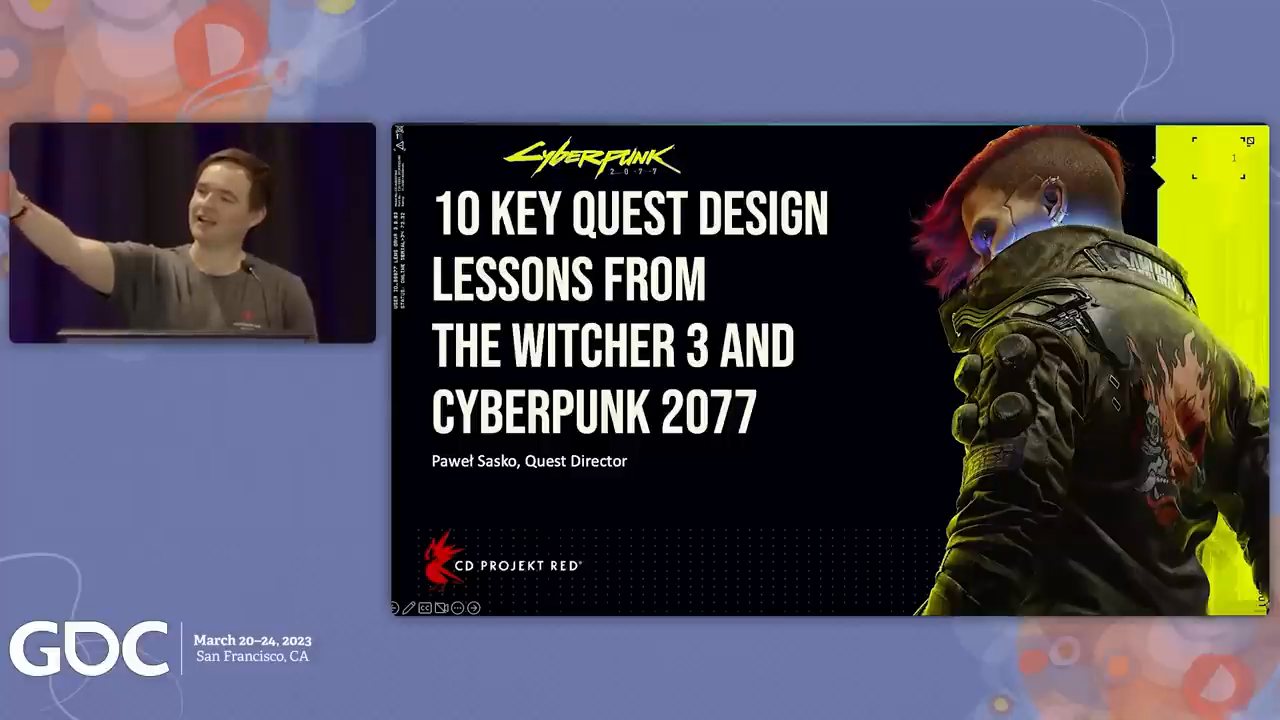
1. The Speaker
Paweł Sasko is a Quest Director at CD Projekt Red, where he directs the quest, open world, and cinematic departments — roughly 60 people. His credits include Two Worlds II, The Witcher 2: Enhanced Edition, The Witcher 3: Wild Hunt (senior quest designer on main story and side quests), Hearts of Stone and Blood and Wine (lead quest designer), Cyberpunk 2077, and Phantom Liberty. He has been in the industry for almost 19 years.
2. The Narrative Pipeline
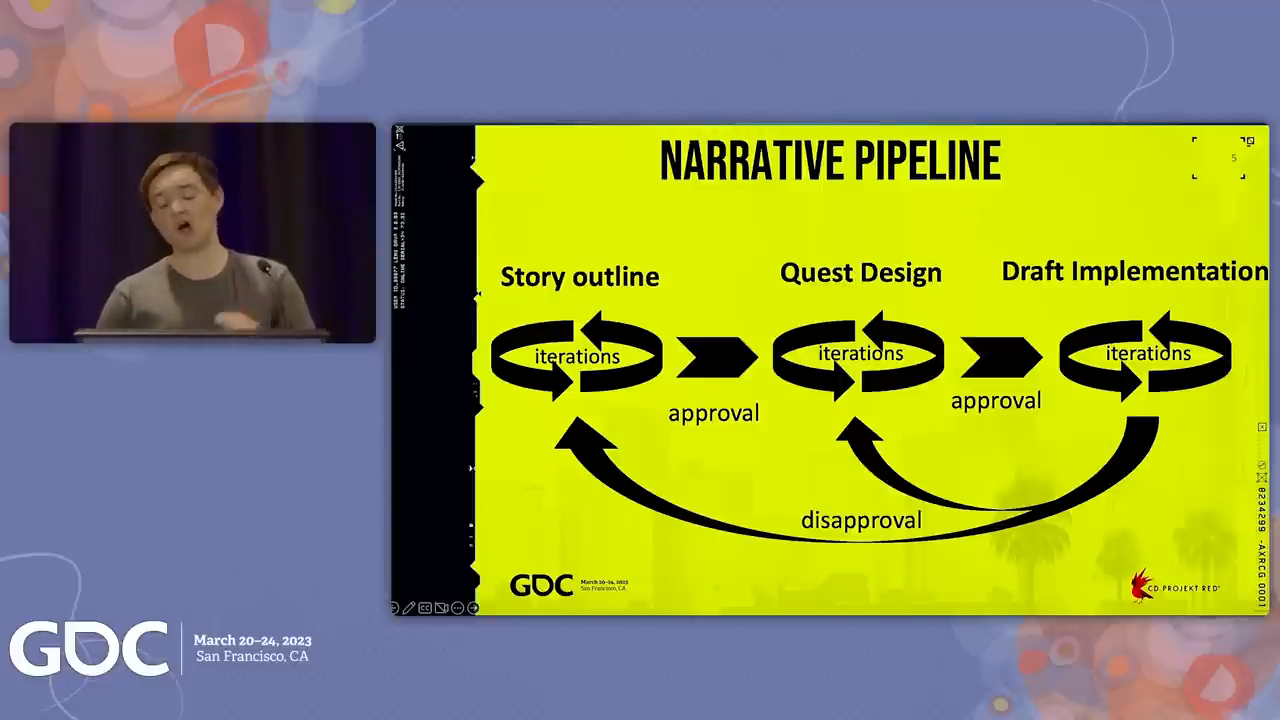
Before diving into design lessons, Sasko outlines how CDPR actually builds their games. The pipeline is critical — it's the reason the games work.
Source: https://www.youtube.com/watch?v=nAkH86__g0o&t=420s
CDPR always starts from a story outline. Writers prepare a short document — sometimes just a few pages — that gets iterated and expanded. Once approved, quest designers produce quest design documents that sit somewhere between a game design document and a movie screenplay. These include rough dialogue sketches but not final writing. The documents are iterated with input from cinematic, open world, writers, and other departments.
Once approved, the team moves to draft implementation: blockout locations from level design, first dialogue drafts sketched by quest designers, and initial gameplay elements. The goal of the draft stage is a fully playable quest — and when all quests are playable, the whole game is playable. From there: pre-alpha, alpha, pre-beta, beta, polish, ship.
The critical detail: work can be sent back to any previous stage. CDPR doesn't move forward until they're genuinely happy with what they've produced. Documents are updated to reflect changes in implementation at least through alpha. This willingness to iterate and bounce back is a key reason the quality bar holds.
3. Part I: Mastering the Plot
The first three lessons address the fundamental craft of making players care about your story.
3.1. Lesson 1 — Engagement
Source: https://www.youtube.com/watch?v=nAkH86__g0o&t=540s
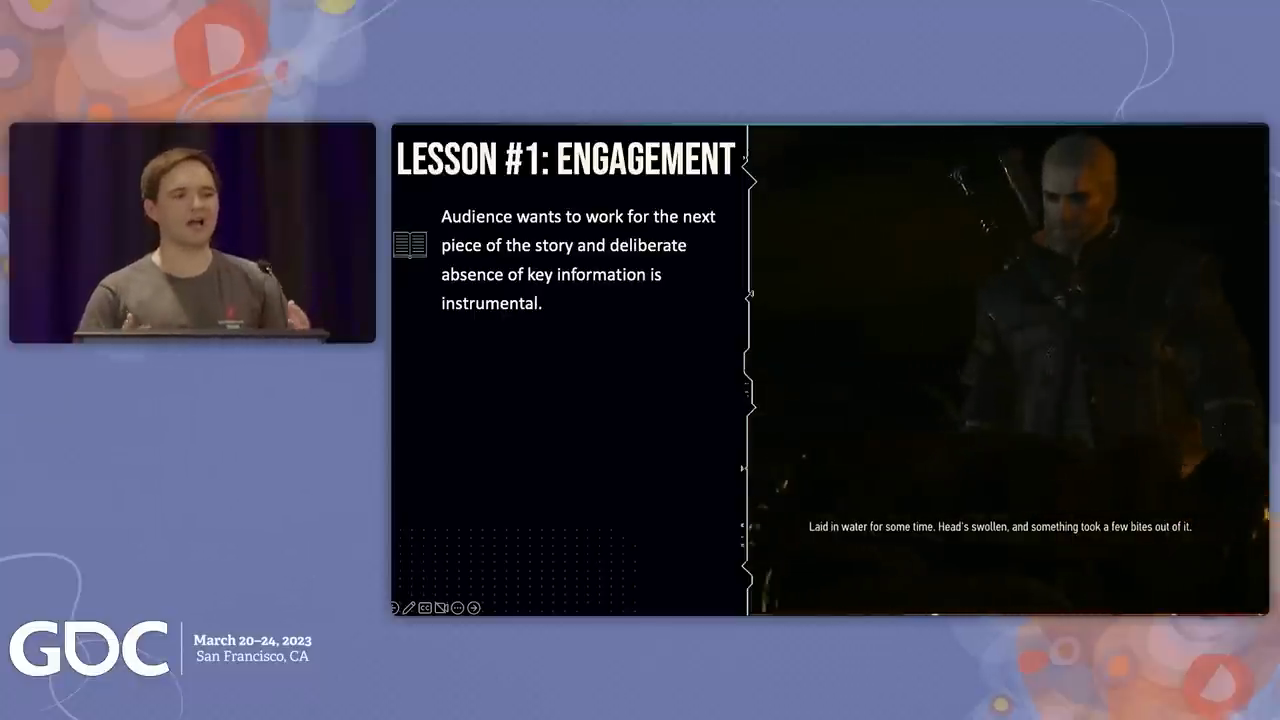
Core principle: By subtracting key information, you make the player crave the story.
Sasko's first example is the opening quest of Blood and Wine — "The Beast of Beauclair." Geralt investigates a gruesome murder where a man is chopped up on a table. Every detail uncovered during the investigation introduces something unexpected. The player is never told what's happening — they're made to want to find out.
He identifies The Witcher 3 as fundamentally a detective game in a fantasy setting — a characterization he credits to a PC Gamer article. The investigation mechanics naturally generate stories built around discovery and curiosity.
His second example is "Dream On" from Cyberpunk 2077, designed by Patrick Mills with writing by Rafael Jaki. Jefferson Peralez hires V to investigate a break-in, but nothing adds up: security has no footage, guards saw nothing, SSI claims it was a bad dream. When V scans mysterious equipment in a back room, the scanning UI deliberately returns "unknown" — a system the player has been taught should identify everything. The designers intentionally broke their own established mechanic to create unease and curiosity.
3.2. Lesson 2 — Impact
Source: https://www.youtube.com/watch?v=nAkH86__g0o&t=870s
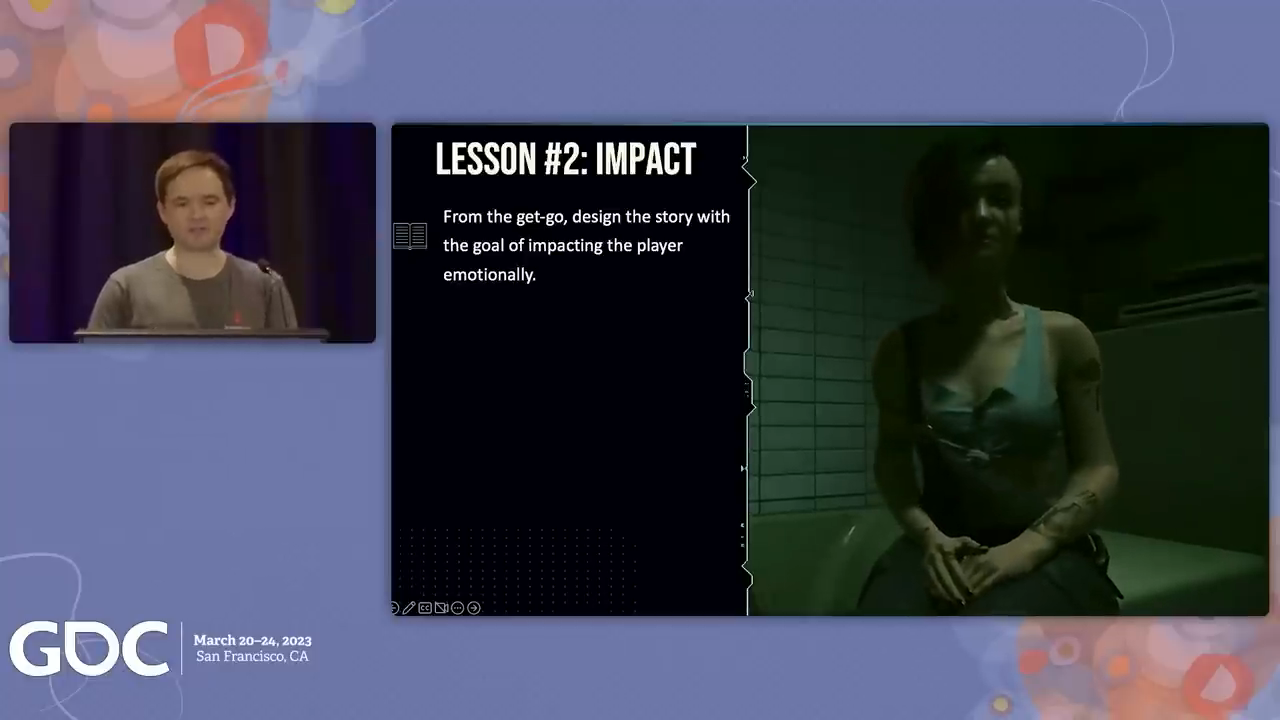
Core principle: Design your story around emotional "banging moments" — scenes that punch the player in the gut.
Sasko uses the Judy storyline in Cyberpunk 2077 as his primary example. There's a moment where Judy breaks down after what happens to her friend Evelyn — makeup dripping down her face, completely devastated. The quest was designed by Sarah Grimmer and written by Magdalena Zych. That specific emotional beat wasn't in the original plan but was discovered to be necessary during development. It was added fairly early once the team recognized the storyline needed it.
His second example is more personal: the Battle of Kaer Morhen in The Witcher 3, which Sasko designed and implemented. He needed a substantial event to transform Ciri from hunted prey into active hunter. He proposed killing Vesemir. The writers were initially unsure, but discussions with Marcin Blacha (story director) led to the conclusion that Vesemir's death was the right catalyst. The character had been carefully built up across many quests, making the moment devastating. Sasko also wanted to surprise players — to do something they wouldn't believe the team would do.
Beyond emotional moments, Sasko introduces "cool scenes" — memorable sequences that may not carry deep emotional weight but stick in memory. The example: Takemura executing Dex DeShawn. It concludes Dex's arc, introduces Takemura as a major character, and is short and punchy. But he warns: if your story is built only from cool scenes with no emotional core, it has no soul. He references the "fire and embers" storytelling theory — fire is the soul of the story; embers are the spectacle. Narrative designers must always tend the fire.
3.3. Lesson 3 — Believability
Source: https://www.youtube.com/watch?v=nAkH86__g0o&t=1470s
Core principle: Give characters space to be human. Don't rush through every moment.
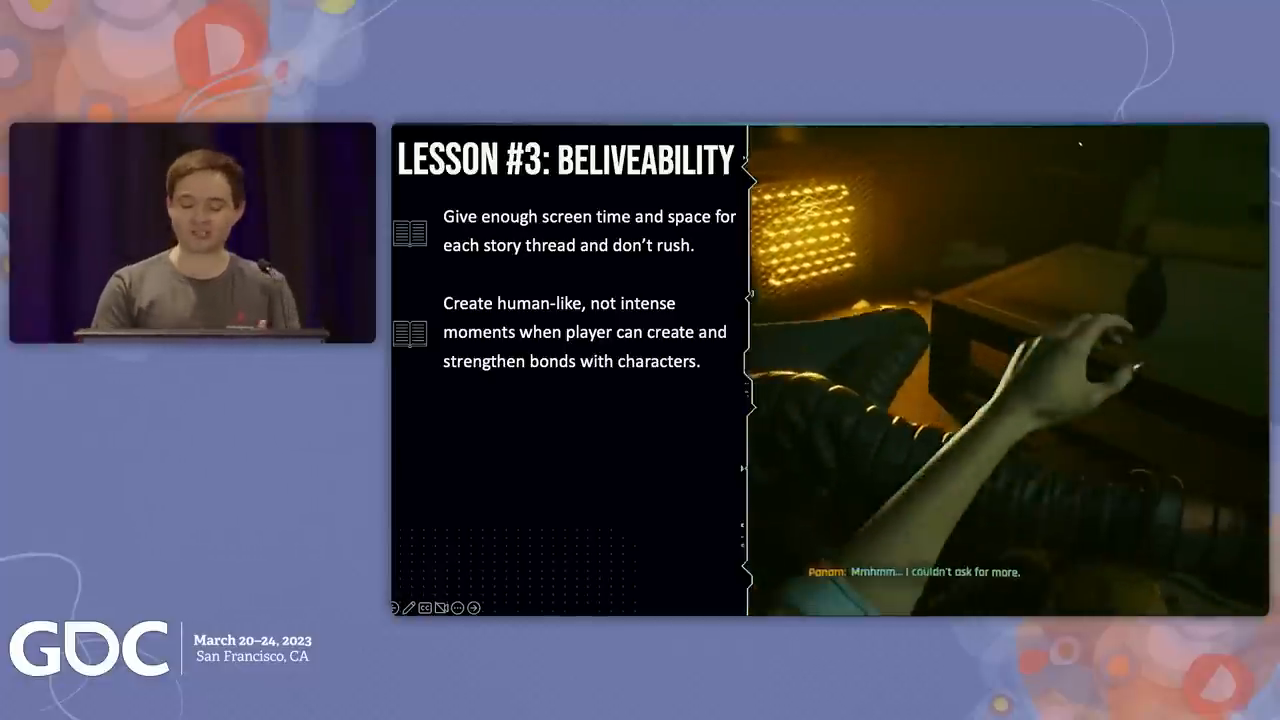
After the intimate scene with Judy in Cyberpunk, there's a moment where V and Judy just lie together, embraced, looking at each other, smoking. No new objectives. No plot advancement. Just being with her. Sasko points out that as humans we intuitively understand this — you don't hug someone and then sprint to take out the trash because that's the next objective. Yet games almost never give characters this breathing room.
He shows the Panam sandstorm scene where she puts her legs on V's legs — a gesture so unusual for games that streamers consistently reacted with surprise. This is normal human behavior, but games have conditioned players to expect nothing but over-the-shoulder dialogue.
The key takeaway: Characters shouldn't only talk about the plot. They should talk about what matters to them. The coffee with Kerry, lying with Judy, the quiet moments with Panam — none of these advance the main storyline. They build relationships. And in AAA development, you need to deliberately reserve budget for these moments.
4. Part II: Structuring the Narrative
The next three lessons address how to construct and pace quests at a structural level.
4.1. Lesson 4 — Brevity
Source: https://www.youtube.com/watch?v=nAkH86__g0o&t=1800s
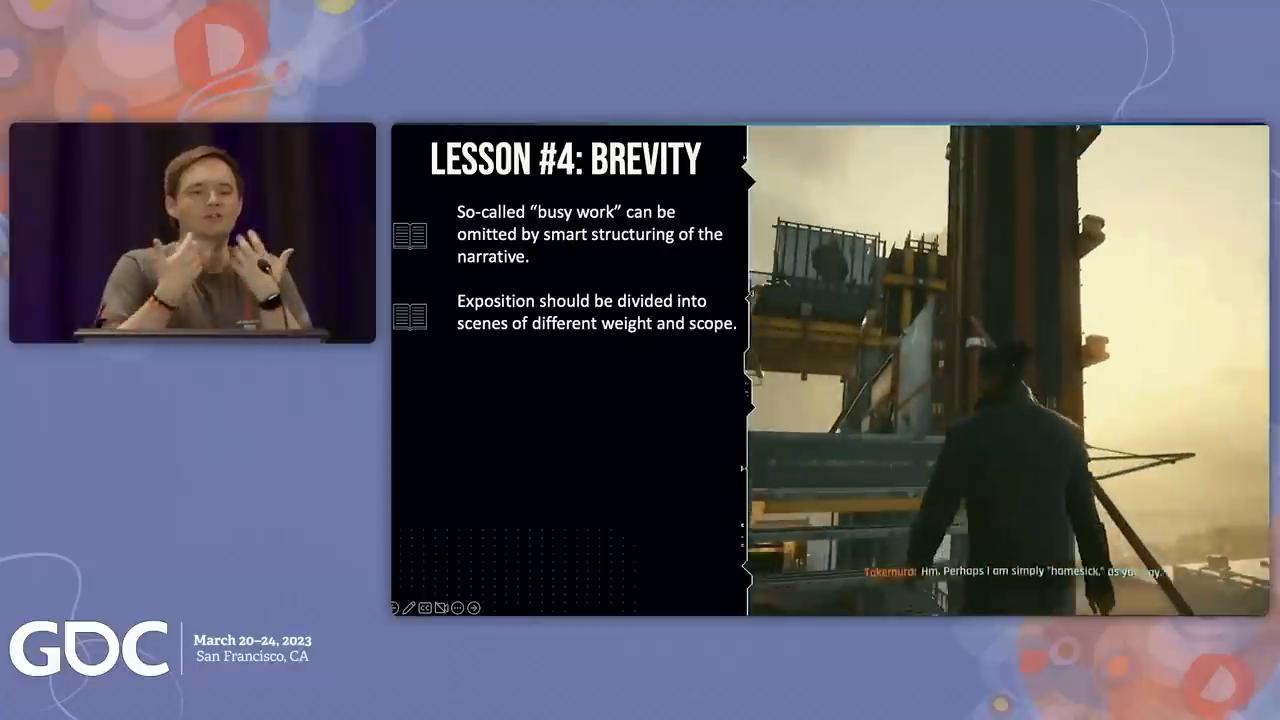
Core principle: Trim the fat. Cinema figured this out long ago — eliminate busy work and repetition.
In the Battle of Kaer Morhen, there's a planning scene before the Wild Hunt attacks. Sasko knew players didn't need to discuss every detail of the defense with Ciri — they were about to see it. So Geralt simply says "let's focus on it and discuss it in detail," it cuts, and you're in the action.
For exposition specifically, Sasko introduces the signal and noise theory. Signal is the important information you want the player to receive. Noise is everything the player can do simultaneously that competes with that signal. In Cyberpunk's first-person perspective, you're always in V's shoes with no cutscenes, so exposition must be strategically divided:
- Walk-and-talk sequences (high noise, low signal): The player can jump around, look away, throw grenades. Only less critical information goes here.
- Seated/focused sequences (low noise, high signal): Camera control is limited, the player is face-to-face with a character. All crucial plot and character information is delivered here.
He also advocates for subtle exposition — environmental storytelling that communicates world values without ever pointing a finger at them. The receptionist at Konpeki Plaza with dark gold skin as part of her work attire, commercials on TV, radio content — all communicate what Night City is without a single line of explicit exposition.
4.2. Lesson 5 — Choices
Source: https://www.youtube.com/watch?v=nAkH86__g0o&t=2010s
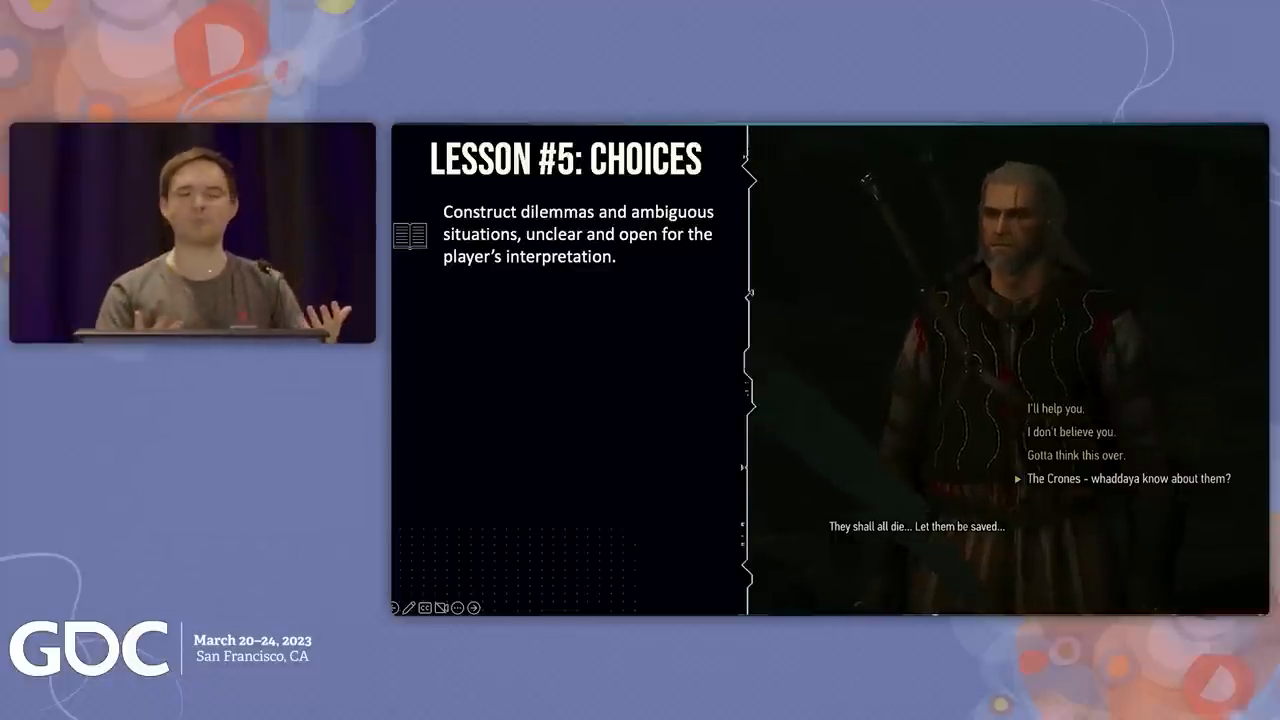
Core principle: The best choices are moral dilemmas where both sides have been carefully built up and neither outcome is obviously "right."
The Whispering Hillock choice in The Witcher 3 (the tree spirit in Velen) is Sasko's primary example. Both sides of the dilemma are deliberately constructed so the player can't predict the consequences. Bad things happen no matter what you choose. This is by design — sometimes the play between creator and audience means ensuring there is no clean win.
He articulates a design philosophy: when it feels right that a choice should exist, provide it. When players feel they should be able to do something — punch Placide after he double-crosses you, confront Fingers — the game should offer that option. The team constantly playtests and asks: "Does it feel fine that I can't do something here?" Sometimes the answer is yes (you want to make a narrative point), but you need to be deliberate about it.
A negative example: the race for the Skellige crown between Cerys and Hjalmar. Cerys was more interesting, better written, had more screen time, and looked more compelling. Most players chose her. The team didn't balance both sides well enough. When constructing choices, you must account for asymmetries in screen time, writing quality, and even "star power" — as they learned with Keanu Reeves' Johnny Silverhand, whose celebrity presence inherently skewed player choices toward siding with him.
4.3. Lesson 6 — Consequences
Source: https://www.youtube.com/watch?v=nAkH86__g0o&t=2610s
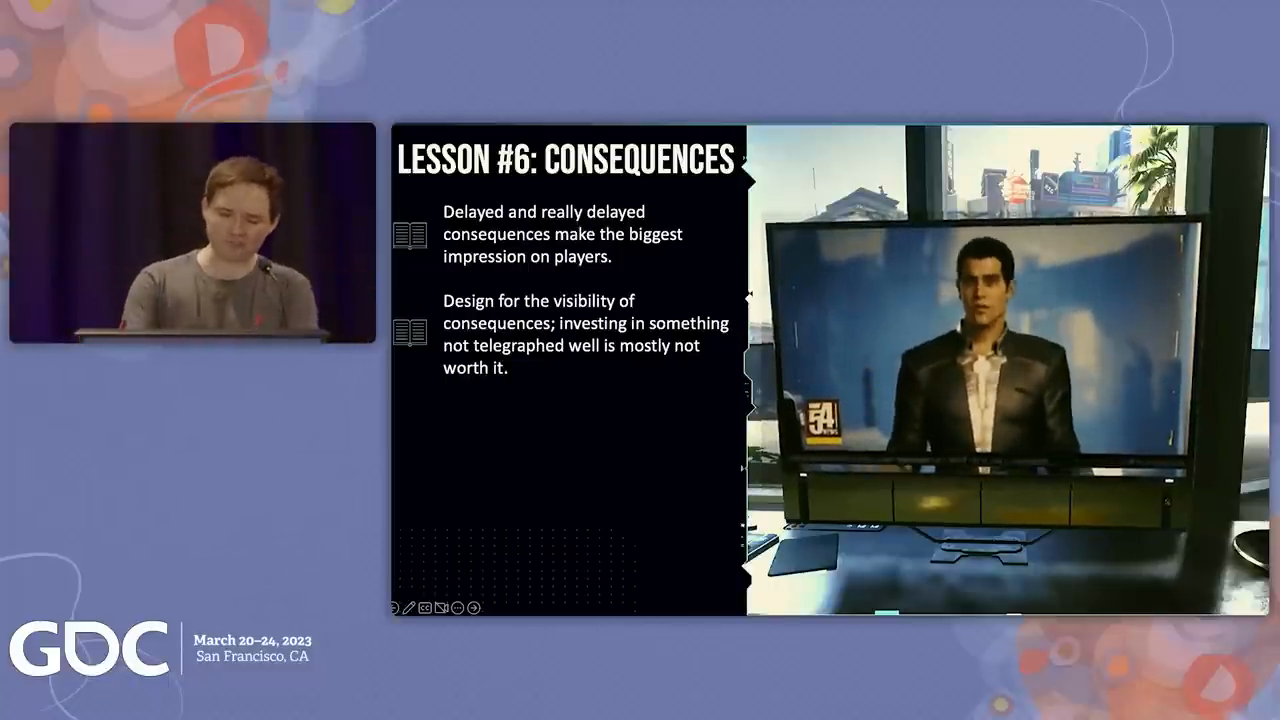
Core principle: Telegraph consequences on every possible level. If players can't see them, they don't exist.
Sasko's primary example is the Totentanz quest, which he designed. When the player returns to the Maelstrom club much later in the game, their choices from the All Foods factory in the prologue ripple forward: if you allied with Maelstrom, Dum Dum greets you; if you killed them, Patricia has taken over. Different characters walk you through different paths and rooms.
This is what CDPR calls telegraphing — showing consequences to the player using every available tool. The delayed consequences (prologue choice paying off late in the game) are the most impressive, but they require careful reminders. Characters explicitly reference past events: "Hey, that's the gonk from All Foods." These lines exist specifically to remind the player what they did, because players may have spent days, months, or years between the choice and its consequence.
A negative example: CDPR invested heavily in TV and radio content that changed based on player choices. Almost nobody noticed. Players who didn't find the consequences assumed they weren't there at all. Redditors eventually documented them, but that's a fraction of the player base. Design for visibility — consequences that aren't clearly telegraphed are wasted budget.
5. Part III: Improving the Design
The final four lessons address higher-order craft — restraint, courage, innovation, and teamwork.
5.1. Lesson 7 — Overdesign
Source: https://www.youtube.com/watch?v=nAkH86__g0o&t=2760s
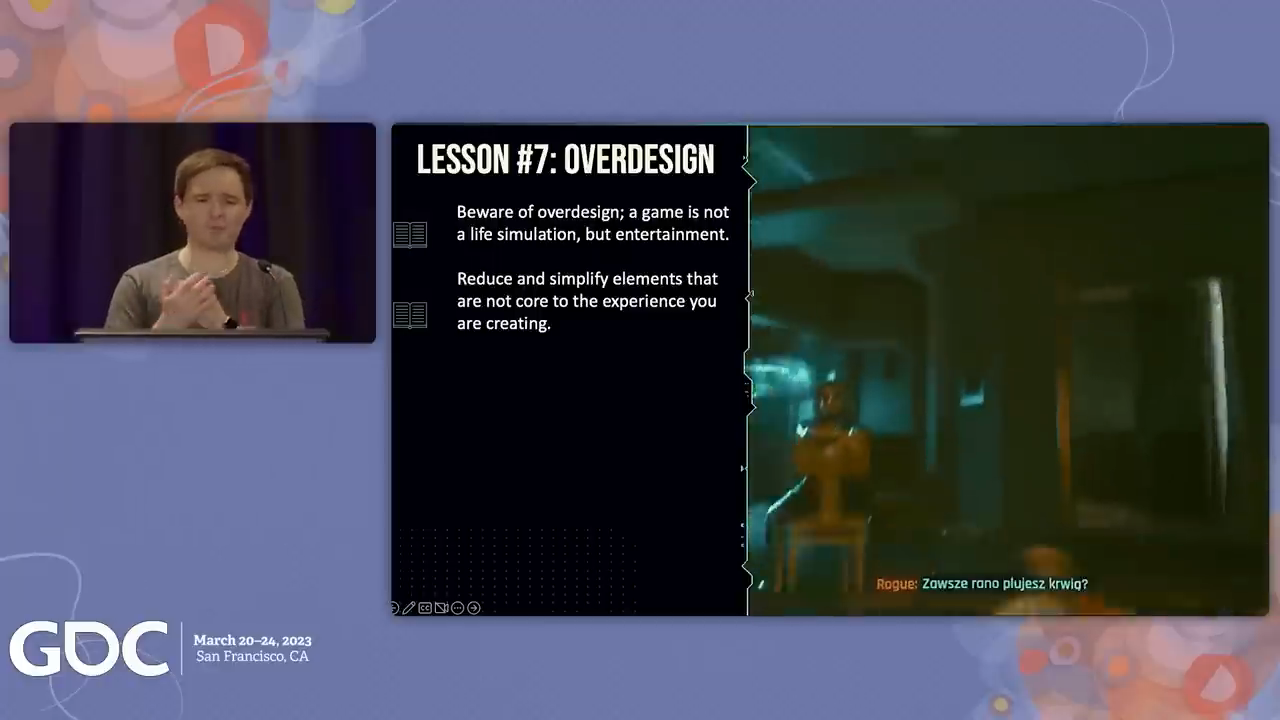
Core principle: A game is entertainment, not a life simulation. Always ask: "Why is this even in the game?"
Early in Cyberpunk's development, Panam appears briefly in a bar during the prologue. There were discussions about whether she should finish her beer, walk to her car, drive to the Badlands, meet the Nomads — and the player could follow her through all of it. Sasko's response: what's the point? Details are amazing when they matter, when there's meaning behind them. Adding detail for detail's sake is overdesign.
In the "Cool Metal Fire" quest (Johnny's first takeover of V's body), Sasko chose to skip the scene where Johnny-as-V explains everything to Rogue. Instead, a simple cut jumps to the aftermath — V wakes up in a hotel with blood on their hands, and Rogue already knows what she needs to know. The scene would have just repeated information the player already had.
One of his designers even changed his Slack title to "Quest Over-Designer" in acknowledgment.
5.2. Lesson 8 — Bravery
Source: https://www.youtube.com/watch?v=nAkH86__g0o&t=3060s
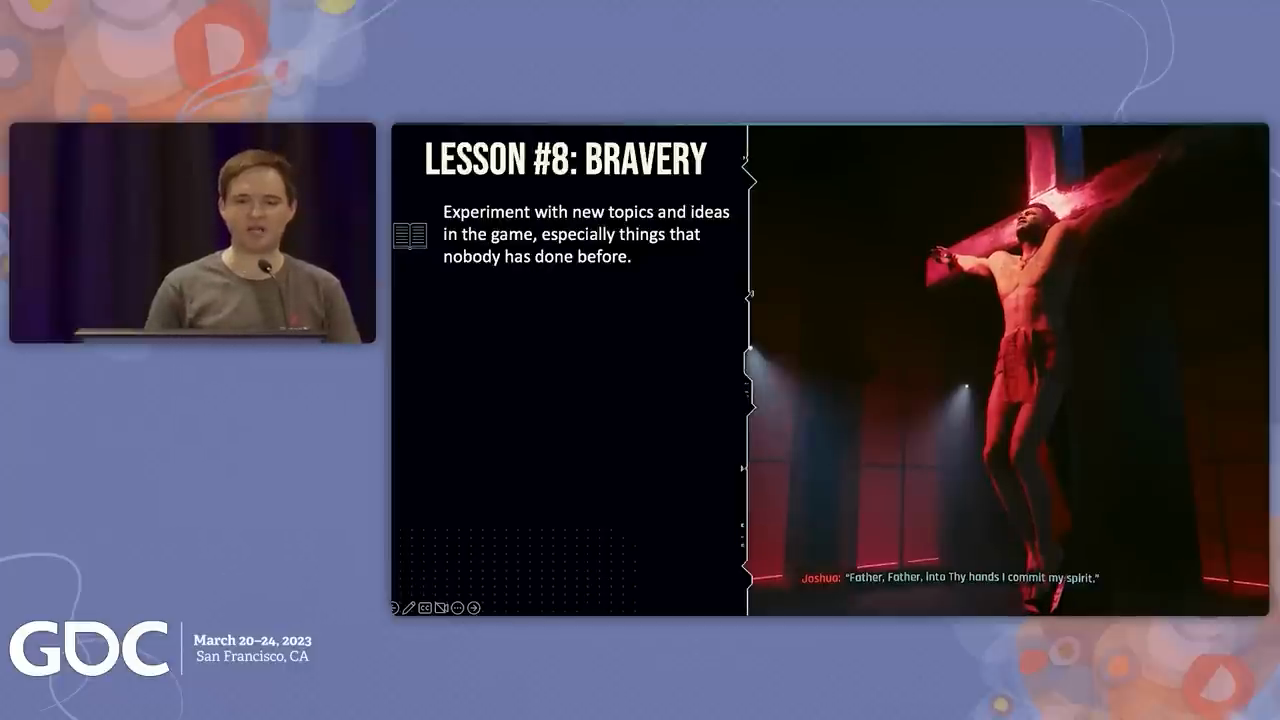
Core principle: Embrace artistic bravery. The AAA industry is too safe — tackle themes that matter, even when they're uncomfortable.
The crucifixion of Joshua Stevenson in Cyberpunk 2077 is Sasko's centerpiece example. A death-row convict who found God wants to die on a cross while his experience is recorded as a braindance for others to relive. The quest originally ended when the player delivered Joshua to the BD studio. Sasko pushed for more: he wanted the player to be the Roman soldier hammering the nails. The interactive scene system made it possible to put the player in that experience directly.
This isn't shock for shock's sake — the quest is deeply contextual, about religion, belief, and spirituality in a dark world. But Sasko argues that AAA studios are paralyzed by caution while indies tackle difficult themes more readily.
He draws a parallel to the Bloody Baron questline in The Witcher 3, which dealt with domestic violence and featured a botchling — a creature born from Baron's wife's miscarriage. Some team members with young children were uncomfortable. But when Sasko explained the thematic purpose — it's about a broken father confronting what he's done to his family — the team understood. In 2012, no AAA game was tackling themes like this.
The "Don't Fear the Reaper" ending, proposed by quest designer Eryk Fijałkowski, exemplifies bravery in game mechanics: a one-man suicide assault on Arasaka Tower where death means the credits roll as your ending. The team's reaction: "This is so bold — we should probably do it."
5.3. Lesson 9 — Novelty
Source: https://www.youtube.com/watch?v=nAkH86__g0o&t=3480s
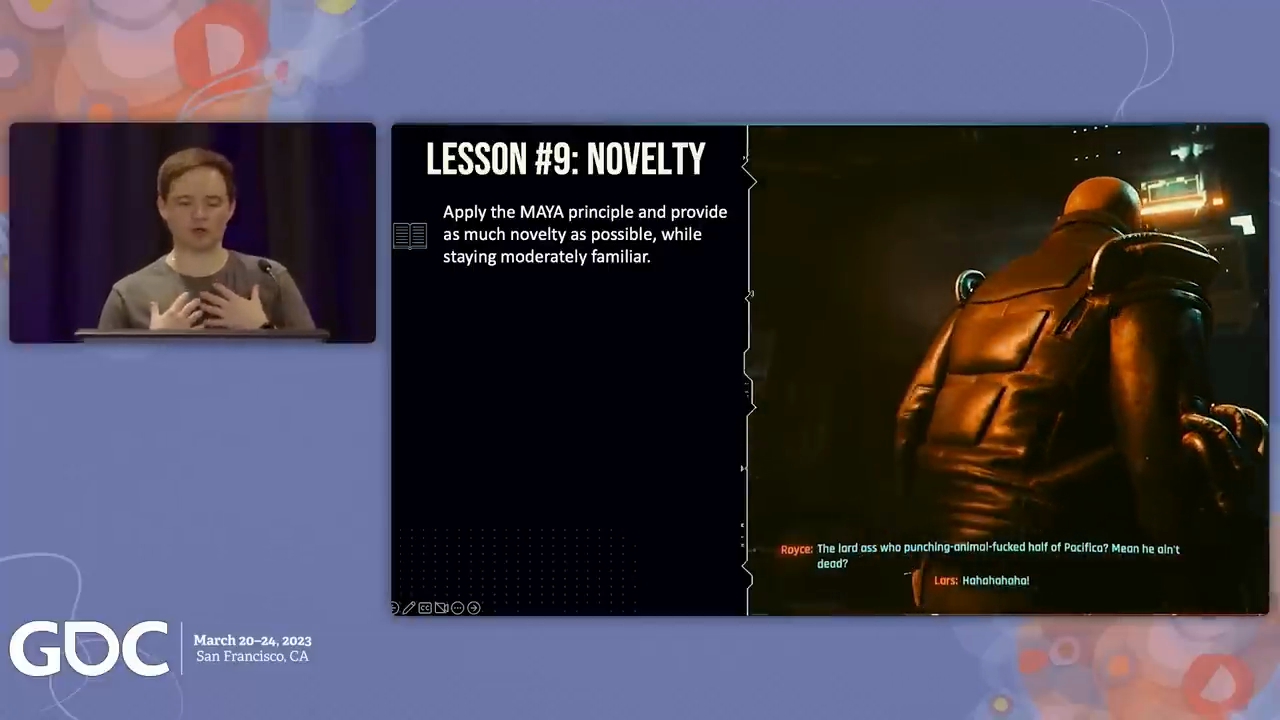
Core principle: Follow the MAYA principle — Most Advanced Yet Acceptable. Push novelty as far as you can while keeping the experience familiar enough that players aren't lost.
Cyberpunk's first-person interactive scene system was a major innovation. The All Foods/Maelstrom encounter demonstrates it: constant staging changes, characters moving in and out of frame, Royce appearing through a door in the background. It took significant iteration to understand how to build these scenes effectively. Many players initially didn't even realize they could move their heads during conversations because previous games had trained them to expect static cameras.
Sasko adds a supporting rule: establish rules before you break them. Young designers love breaking rules, but you need to demonstrate the rules exist first for the breaking to have impact.
5.4. Lesson 10 — Effectiveness
Source: https://www.youtube.com/watch?v=nAkH86__g0o&t=3600s
Core principle: Know your team's strengths and design to let them shine.
When designing the Samurai concert sequence, Sasko knew his cinematic designer (Jason) and animator (David Cordero) were both guitar players who loved that material. He deliberately designed the quest to showcase their passion and expertise. This requires genuine human bonds with your teammates — knowing their strengths, weaknesses, and what excites them.
He also emphasizes paying attention to what other designers are building. The Parade quest in Cyberpunk (by Philipp Weber) was designed with awareness of what already existed in the game, ensuring it offered something different. Creative teams that communicate well avoid duplicating each other's ideas and solutions.
Finally, he highlights "Pyramid Song" (by Sarah Grimmer) as a model of cross-discipline collaboration — one of the most beloved Cyberpunk quests, where quest design, cinematic, animation, and every other discipline were fully aligned because the designer knew every team member's capabilities and how to push them to their best work.
6. Takeaways
Source: https://www.youtube.com/watch?v=nAkH86__g0o&t=3720s
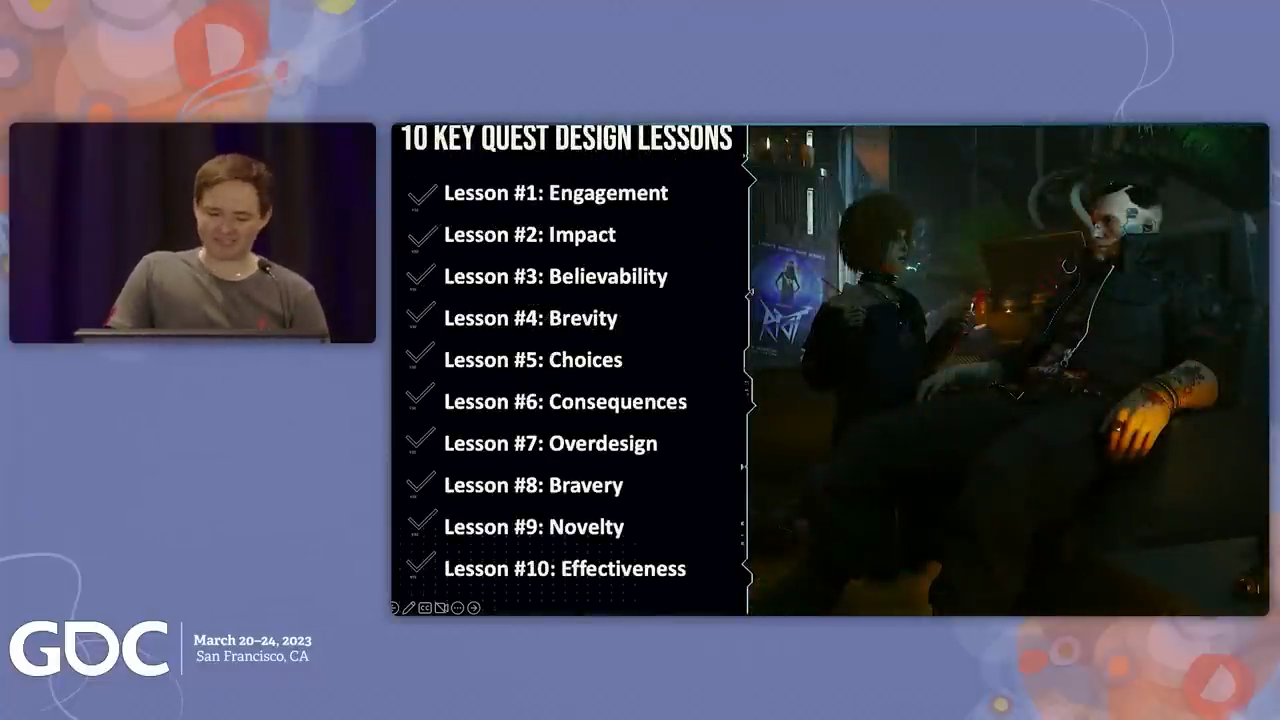
- Engagement — Make the player want the story through deliberate subtraction of information
- Impact — Design around emotional banging moments from the very beginning
- Believability — Give characters screen time and space to be human; don't rush
- Brevity — Cut busy work; divide exposition by signal weight using noise theory
- Choices — Construct genuine moral dilemmas where neither side is obviously correct
- Consequences — Telegraph on every level; delayed consequences impress most; design for visibility
- Overdesign — Games are entertainment, not life simulations; cut what doesn't serve the experience
- Bravery — Tackle difficult themes with context and purpose; the industry is too safe
- Novelty — Apply MAYA: push innovation while maintaining enough familiarity
- Effectiveness — Design for your team's strengths; know your collaborators as people
7. References
- Paweł Sasko. "10 Key Quest Design Lessons from 'The Witcher 3' and 'Cyberpunk 2077'." GDC 2023. https://www.youtube.com/watch?v=nAkH86__g0o