Abstract
Problem: Cyberpunk 2077 shipped with elaborate non-linear levels supporting multiple playstyles, yet players consistently reported that their build choices didn't feel like they mattered. How can a level designer create branching paths that make each player's chosen route feel genuinely special?
Approach: Miles Tost, Level Design Acting Lead at CD Projekt Red, conducted an internal R&D project comparing Cyberpunk 2077's level designs against immersive sim benchmarks (Dishonored, Deus Ex, Batman Arkham). He dissected what went wrong, identified two recurring structural problems, and formulated a set of principles to fix them. Presented at the GDC 2023 Level Design Summit.
Findings: CDPR's "generic path as fallback" approach inadvertently made the default route the most obvious and rewarding one, while playstyle-specific paths mostly just let players skip content — effectively punishing investment. The fix involves restructuring levels around "Discovery and Exploration" beats and three core principles: Perception of Distance (spread paths apart), Perception of Exclusivity (control line of sight between paths), and Perception of Uniqueness (provide exclusive content on each path). The key trade-off: designers must accept that players will miss cool things — but only because they're experiencing other cool things.
Key insight: Players missing out on content isn't a failure — it's the mechanism that makes their chosen path feel special. A choice without real consequence isn't a choice at all.
1. The Speaker
Miles Tost is the Level Design Acting Lead at CD Projekt Red. He has worked at the studio for over 10 years, contributing to The Witcher 3: Wild Hunt (Blood and Wine expansion), and served as a level designer on Cyberpunk 2077. At the time of the talk, he was leading the level design team on the studio's upcoming Witcher game.
2. Part I: The Challenge
2.1. About Cyberpunk 2077
Source: https://www.youtube.com/watch?v=lXLRd5Kah-I&t=150s
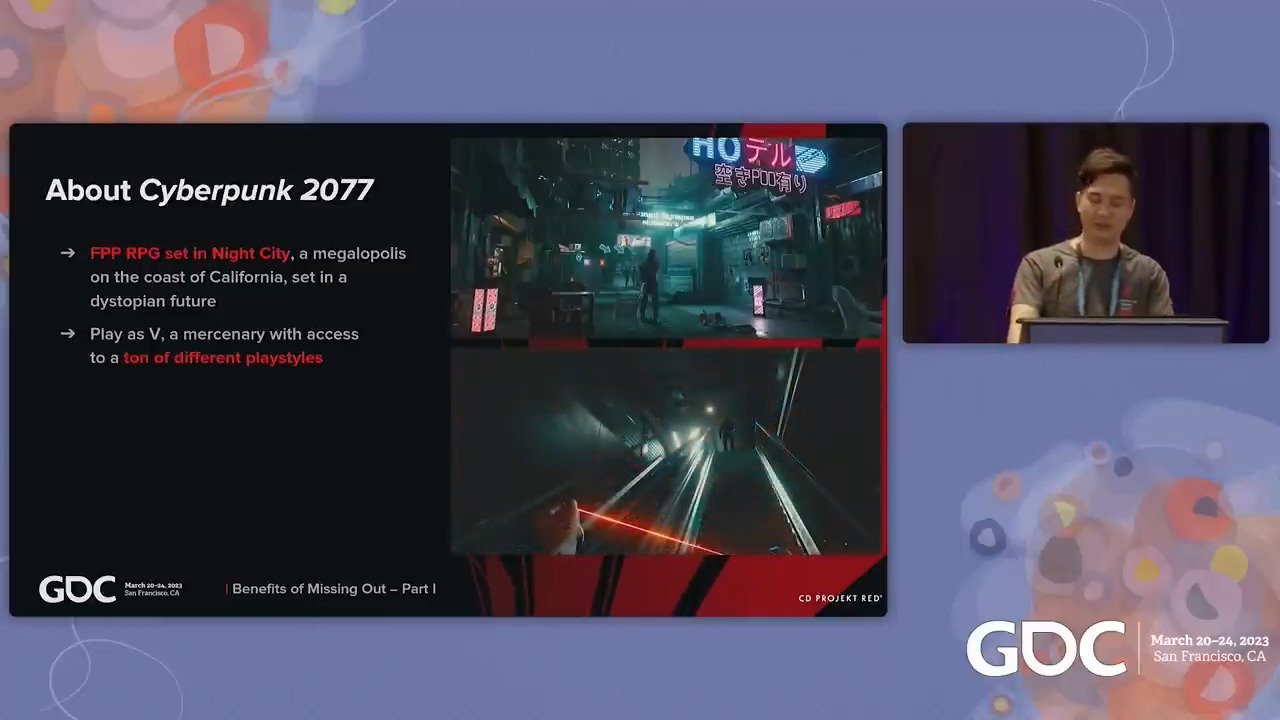
Tost sets the stage by contrasting Cyberpunk with The Witcher 3. After four years of working on a medieval fantasy world — wide open landscapes, a predefined character, third-person perspective — the level design team moved to a first-person RPG set in a claustrophobic megalopolis where the player character V was meant to support total gameplay freedom.
CDPR's games are built on three pillars: freedom in story, freedom in the world, and freedom in gameplay. The first two drove The Witcher 3. The third — freedom in gameplay — was the big new addition for Cyberpunk, inspired by immersive sim titans like the original Deus Ex.
2.2. High-Level Design Goals
Source: https://www.youtube.com/watch?v=lXLRd5Kah-I&t=270s
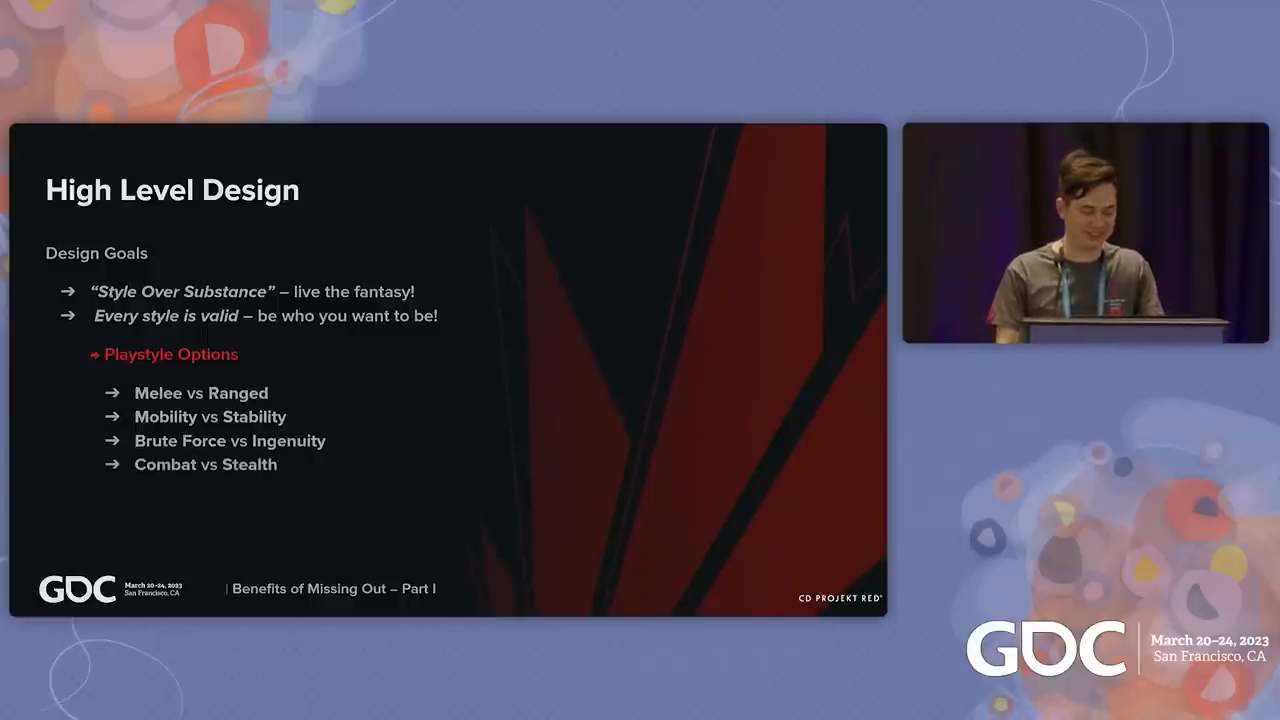
"Style Over Substance" — a motto from Mike Pondsmith's original Cyberpunk pen-and-paper universe — meant players should be able to apply the rule of cool to everything. Every playstyle combination should be valid. The level design team was asked to build levels supporting melee vs ranged, mobility vs stability, brute force vs ingenuity, and combat vs stealth.
These levels had to function within a massive open world, accommodate complex branching narratives, and work with the cinematic first-person scene system — all built by a team of only four to five level designers, none of whom had done immersive sim-style design before.
2.3. The Archetype Approach
Source: https://www.youtube.com/watch?v=lXLRd5Kah-I&t=390s
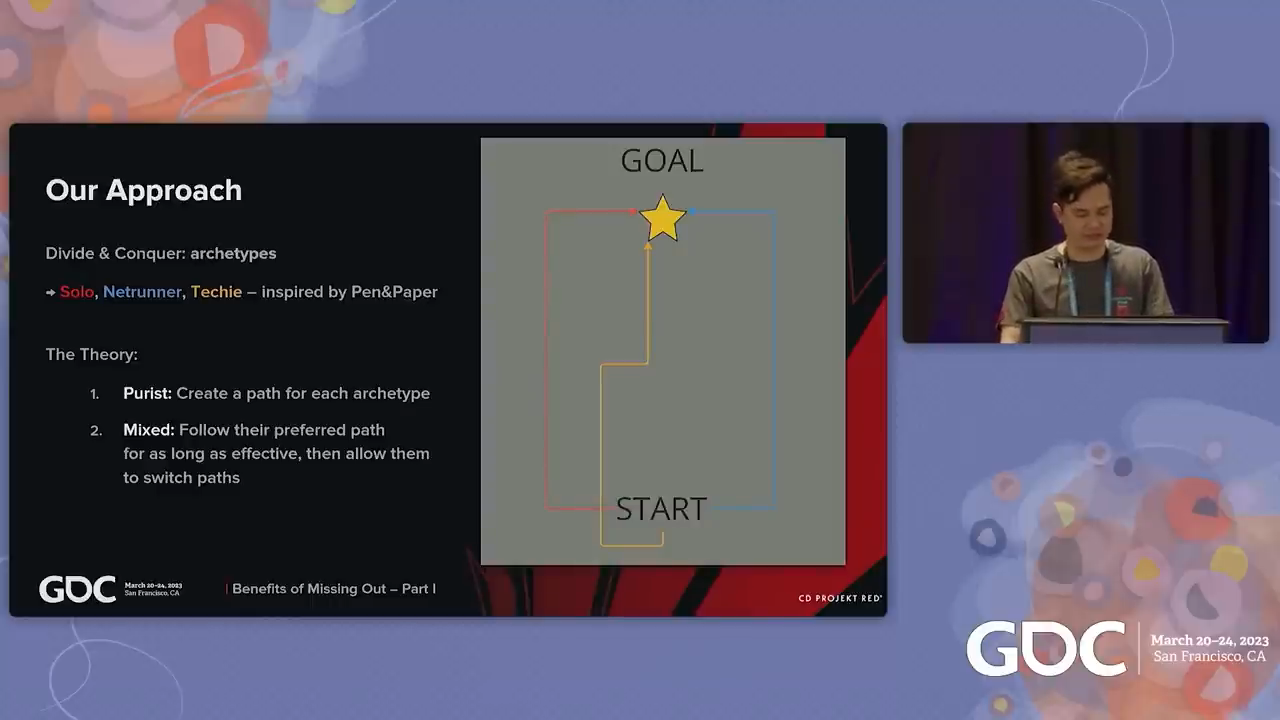
The team structured levels around three archetypes from the pen-and-paper source material: Solo (combat-focused), Netrunner (hacking), and Techie (technical). The theory:
- Purist players who fully invested in one archetype would get their own unique path through each level
- Mixed players would follow their preferred path for as long as it remained effective, then switch to another
To prevent players from getting stuck, the team added a generic path — a fallback free from all skill checks. This path was deliberately designed to be the hardest, encouraging players to use their invested skills instead. Playstyle paths would provide the least resistance, feeding the power fantasy.
In practice, the Techie archetype played too similarly to the Netrunner and was downscaled from a full archetype to a supporting playstyle.
2.4. Anatomy of a Level
Source: https://www.youtube.com/watch?v=lXLRd5Kah-I&t=510s
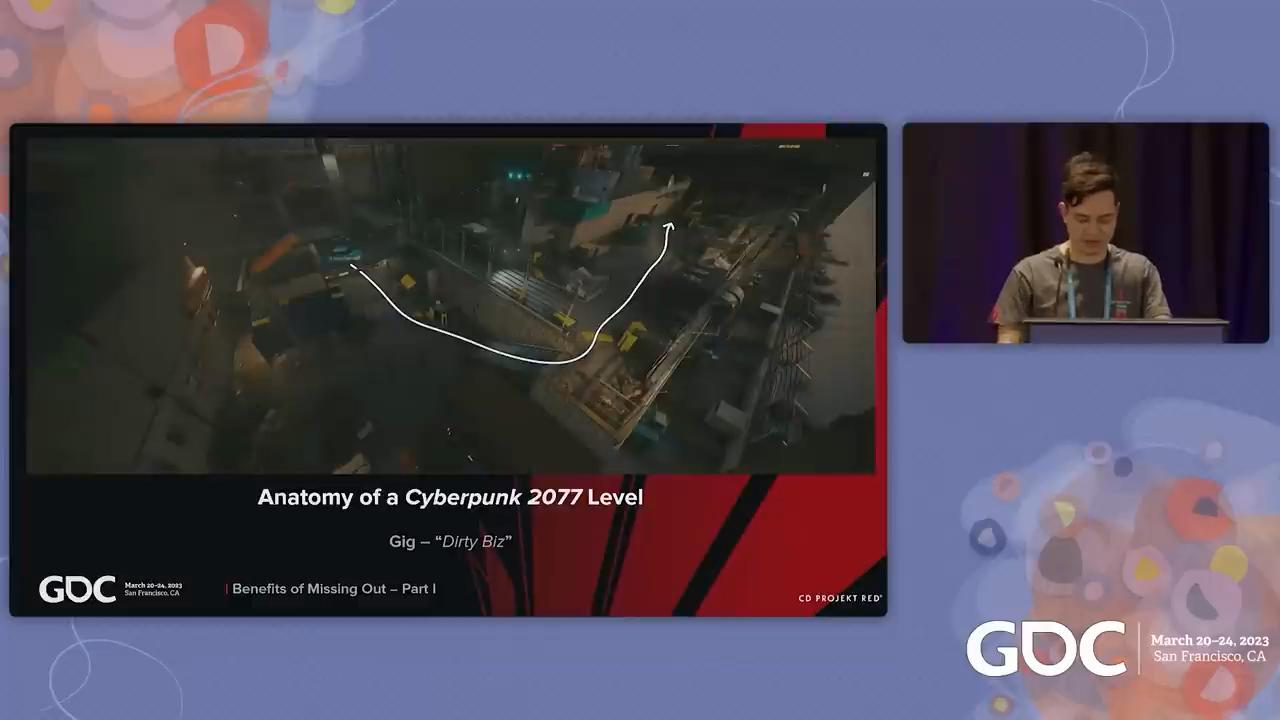
Tost walks through "Dirty Biz," a gig location he created the base blockout for early in development. It illustrates the initial design assumptions:
- Generic/stealth/combat path: These coincided, with stealth focused on timing windows to bypass patrols
- Solo path: Using double jump to infiltrate through an alternative entrance
- Netrunner path: Hacking devices used as "breadcrumbs" leading through the level
- Techie path: Breaking in through a completely different route
The team also shows the "Disasterpiece" main quest — the Braindance Studio location — played two completely different ways: first as a careful stealth run, then as aggressive combat. Balancing these required constant scripting adjustments for NPC behavior that could transition between stealth and combat at any moment.
2.5. Player Experience — "It Went... Okay"
Source: https://www.youtube.com/watch?v=lXLRd5Kah-I&t=1110s
After launch and several patches, the results were mixed:
What worked:
- Players were happy to experiment with playstyles (a respec mechanic was even added post-launch)
- Balance between playstyle validity was good — no dominant strategy
- Players found creative approaches the team hadn't anticipated (using throwing knives or sandevistan bullet-time for stealth)
What didn't:
- Players felt that whatever playstyle they picked didn't matter — the experience wouldn't drastically change
- The problem was complex: level design was only one part of the equation, alongside the perk system and the team's own design mentality
- The team was trying to create "multiple highly polished linear experiences" rather than interwoven ones where it's up to the player how much they experience
3. Part II: The Plan
3.1. The R&D Mission
Source: https://www.youtube.com/watch?v=lXLRd5Kah-I&t=1230s
In Spring 2022, the level design team launched an internal R&D project. Every level designer would identify one problem in Cyberpunk 2077, analyze it, propose a solution, and present it to the team.
Tost's mission: figure out why players don't feel like their playstyle choices matter from a level design perspective, then formulate principles to improve future designs.
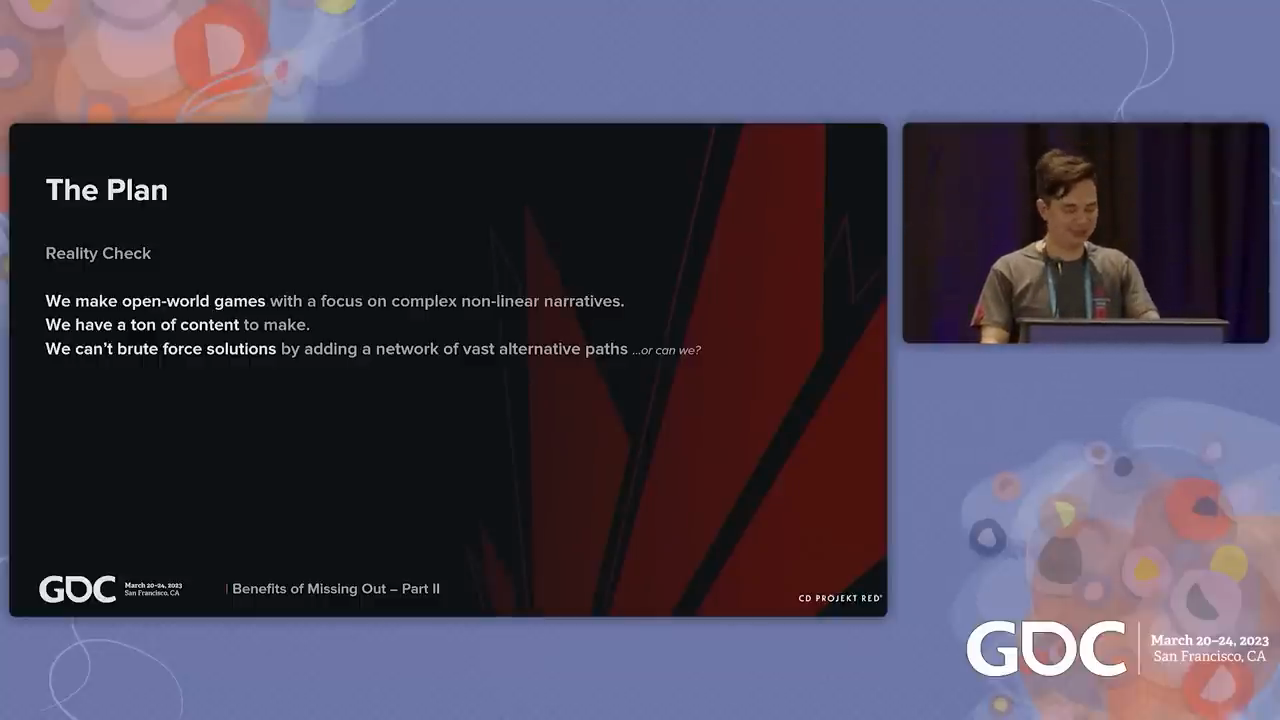
His approach was to revisit the games that inspired them — Dishonored 1 & 2, Batman Arkham, Deus Ex — with the wisdom of hindsight. But a reality check was necessary first:
- CDPR puts narrative first — everything serves the story, with no loading screens between interiors and exteriors
- The sheer volume of content (85+ gigs, ~40 main missions, 25+ side missions) means they can't brute-force solutions with completely separate paths
- Whatever principles emerge must be applicable even at small scale
3.2. Studying the Competition
Source: https://www.youtube.com/watch?v=lXLRd5Kah-I&t=1350s
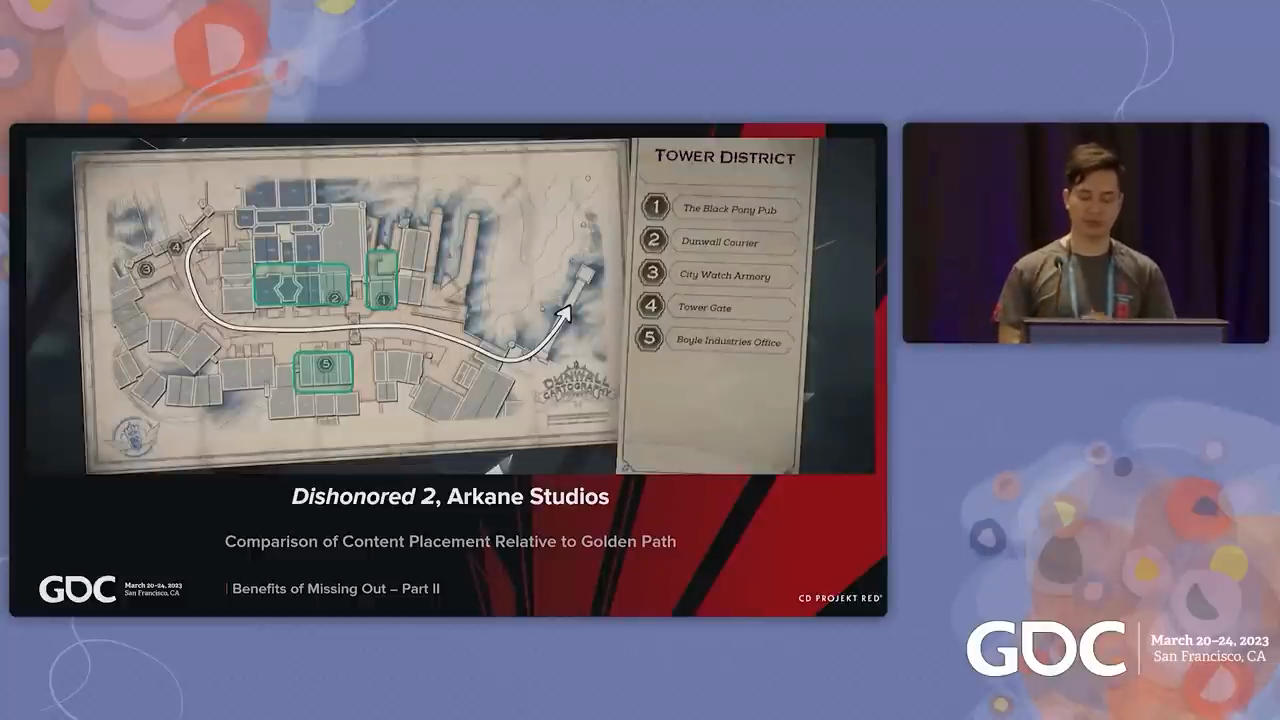
Tost found two major recurring issues across Cyberpunk's levels:
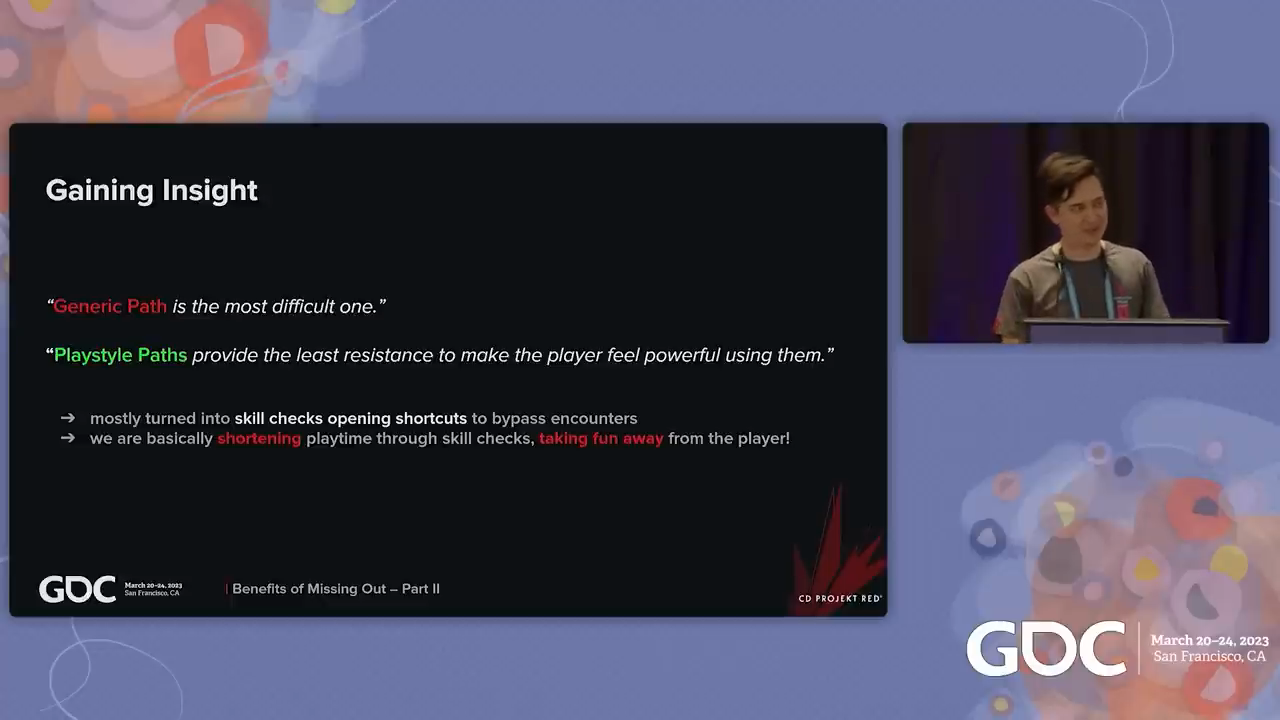
Issue 1: The generic path trap. To ensure the generic path was a reliable fallback, the team made it super obvious — which inadvertently made it the path players would most naturally choose. The minimap guidance system reinforced this. Why pick a playstyle path when the generic solution is right there, easy to reach, and obvious?
Issue 2: Cool content clustered on the generic path. In an effort to give all players the best narrative experience, the team placed the coolest encounters, exposition, lore, and secrets along the generic path or at bottleneck points where all paths converge. This further devalued playstyle paths.
3.3. Gaining Insight — The Core Problem
Source: https://www.youtube.com/watch?v=lXLRd5Kah-I&t=1710s
The diagnosis was damning: skill checks mostly just opened shortcuts to bypass encounters. Players invested their hard-earned attribute and perk points, and as a reward... they got to experience less of the game.
The generic path — meant to be the hardest — was actually the path with the most interesting content. Playstyle paths — meant to feel rewarding — just let you skip stuff.
Tost also shows a specific example from the "I Walk the Line" mission where a skill check unlocks a side passage that completely bypasses a rich, atmospheric gym area full of custom gang chatter and interactions. The team had inadvertently placed the rewarding content on the generic path and made the skill-check path the boring shortcut.
4. Part III: Discovery and Exploration
4.1. The Level Structure Framework
Source: https://www.youtube.com/watch?v=lXLRd5Kah-I&t=1830s
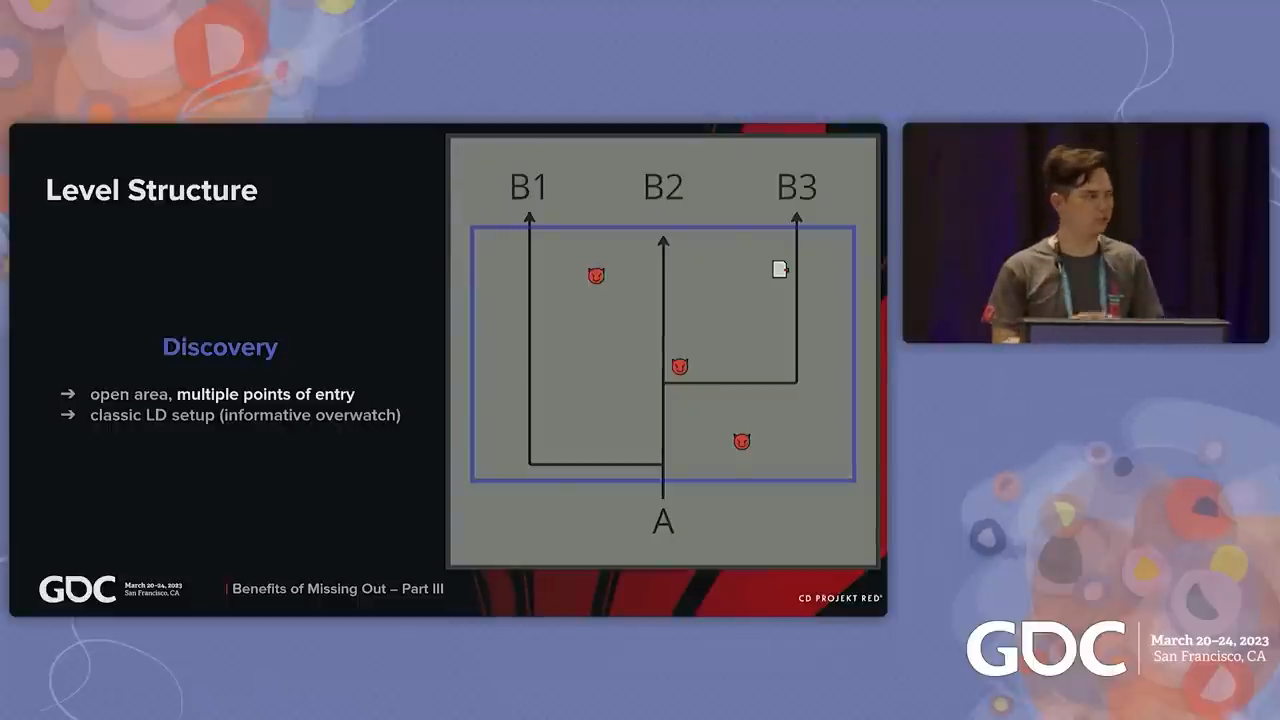
Based on his analysis, Tost developed a level structuring method called Discovery and Exploration, which expands the classic concept of "analysis" (player observes and plans) and "execution" (player acts on their plan).
The method consists of two alternating beats:
Discovery — The establishing shot. An open area with multiple points of entry where the player:
- Discovers their options
- Makes choices
- Overcomes initial challenges
This is where you set the mood, deliver essential narrative information, and plant seeds to tease what players might find later. Crucially: don't overspend your budget here. Save the good stuff for exploration.
Source: https://www.youtube.com/watch?v=lXLRd5Kah-I&t=2070s
Exploration — The payoff. A more intimate, linear experience where the level narrows down and restricts the player to their chosen path. The player:
- Experiences the consequences of their choice
- Gets the reward for having committed
- Encounters exclusive content: world-building, puzzles, special encounters, secrets
The two beats complement each other: Discovery provides choices and gives promises. Exploration delivers consequences and grants rewards. This structure allows the team to still expose all players to important narrative elements during discovery, while giving individual players a unique experience during exploration.
The critical trade-off: it is okay for players to miss cool things, but only if they miss them by experiencing other cool things. The net gain stays in balance.
5. Part IV: The Three Principles
5.1. Principle I — Perception of Distance
Source: https://www.youtube.com/watch?v=lXLRd5Kah-I&t=2220s
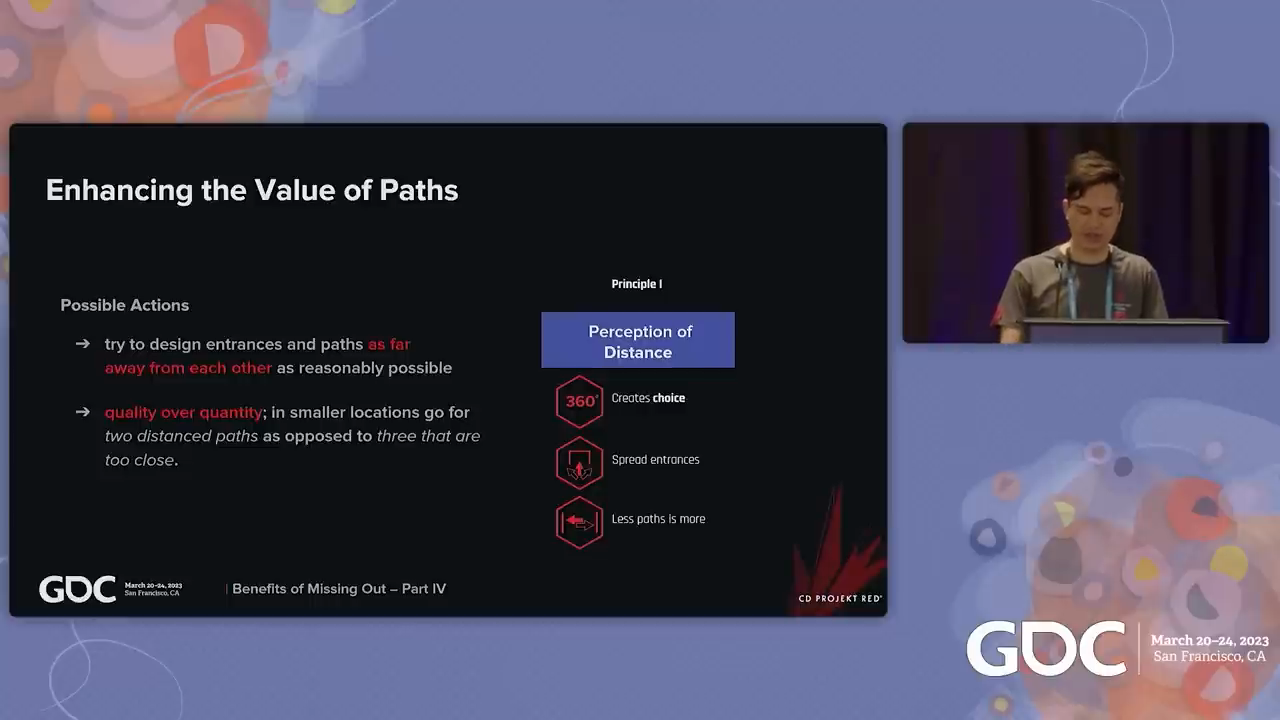
The closer paths are to each other, the less it feels like picking one makes a difference.
When two entrances are right next to each other, there's little mystery about whether the paths are actually different. Even vertical separation doesn't help if the paths run parallel — players perceive them as the same route.
Actionable guidelines:
- Design entrances and paths as far from each other as reasonably possible
- Focus on perceived distance, not just actual distance — limited visibility, encounters, and skill checks between paths all increase perceived distance
- Quality over quantity: Two paths with high perception of distance are better than three that are too close together
- Anything that makes access more difficult (encounter setup, skill checks) increases perceived distance
5.2. Principle II — Perception of Exclusivity
Source: https://www.youtube.com/watch?v=lXLRd5Kah-I&t=2310s
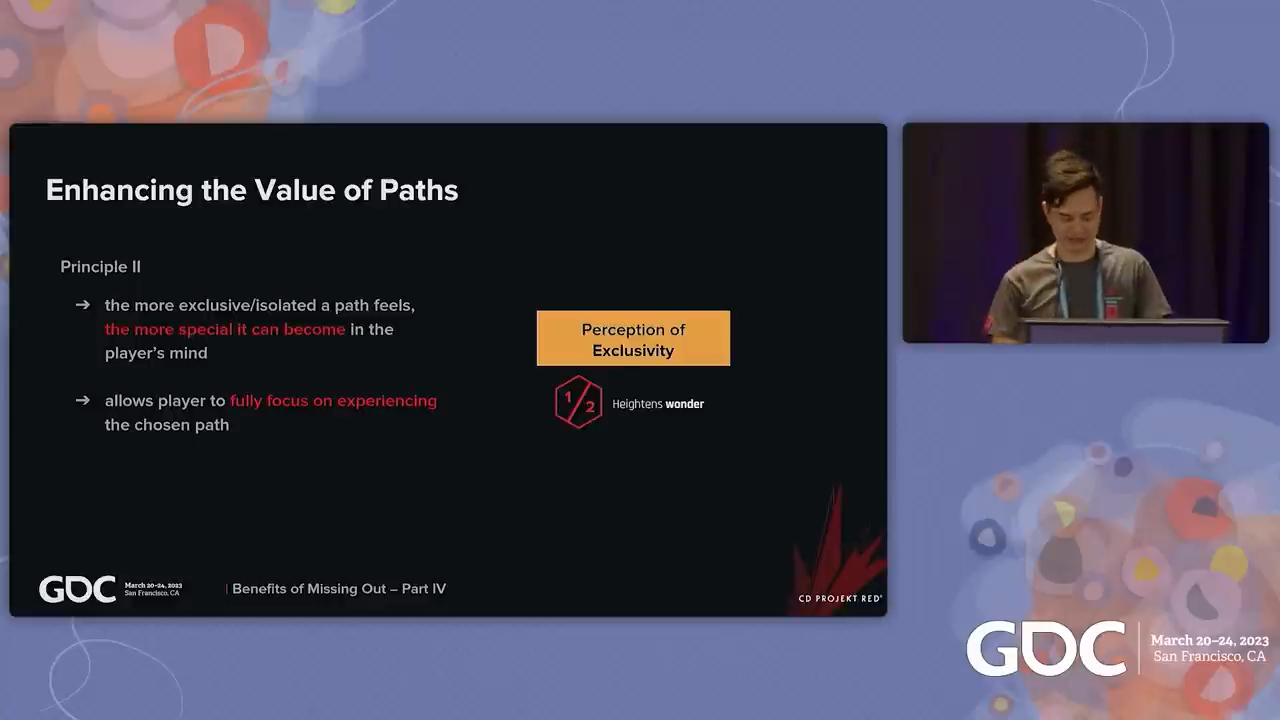
Without exclusivity, players can't even wonder whether another path might lead somewhere different.
If the player can see where an alternative path goes without using it, the illusion is destroyed. Principle I builds choice; Principle II maintains mystery around those choices.
Actionable guidelines:
- Break line of sight between alternative paths and entrances — prevent players from figuring out how other paths work without using them
- Use one-way drops and passages to commit players to their choice
- If your game emphasizes freedom (like Cyberpunk), allow path-switching but at a cost — e.g., sneaking past a particularly deadly enemy
- The more isolated and exclusive a path feels, the more special it becomes in the player's mind
5.3. Principle III — Perception of Uniqueness
Source: https://www.youtube.com/watch?v=lXLRd5Kah-I&t=2430s
A choice isn't interesting without proper payoff. The player did their part — now it's on the designer to make it worth their time.
Perception of Uniqueness validates the player's choice. It fulfills their desire to have made the right choice while heightening the stakes of future choices.
Actionable guidelines:
- Allocate budget for exclusive content on each path: unique scenes, encounters, environmental storytelling, world-building details
- This is where individual designers can shine — kit-bashing cool experiences out of seemingly nothing
- Avoid bottlenecking paths into the same room. Seeing the exit of another path tells players that all paths lead to the same place, destroying the illusion
- Hide path exits from each other so the player keeps wondering: "There was another path... I wonder where that went?"
- CDPR created "Mini World Stories" — small self-contained content pieces that let designers add perception of uniqueness while breathing life into the world (e.g., the dancing robots, the car bomb encounter)
6. Part V: Applied Principles
6.1. The Blockout Iteration
Source: https://www.youtube.com/watch?v=lXLRd5Kah-I&t=2790s
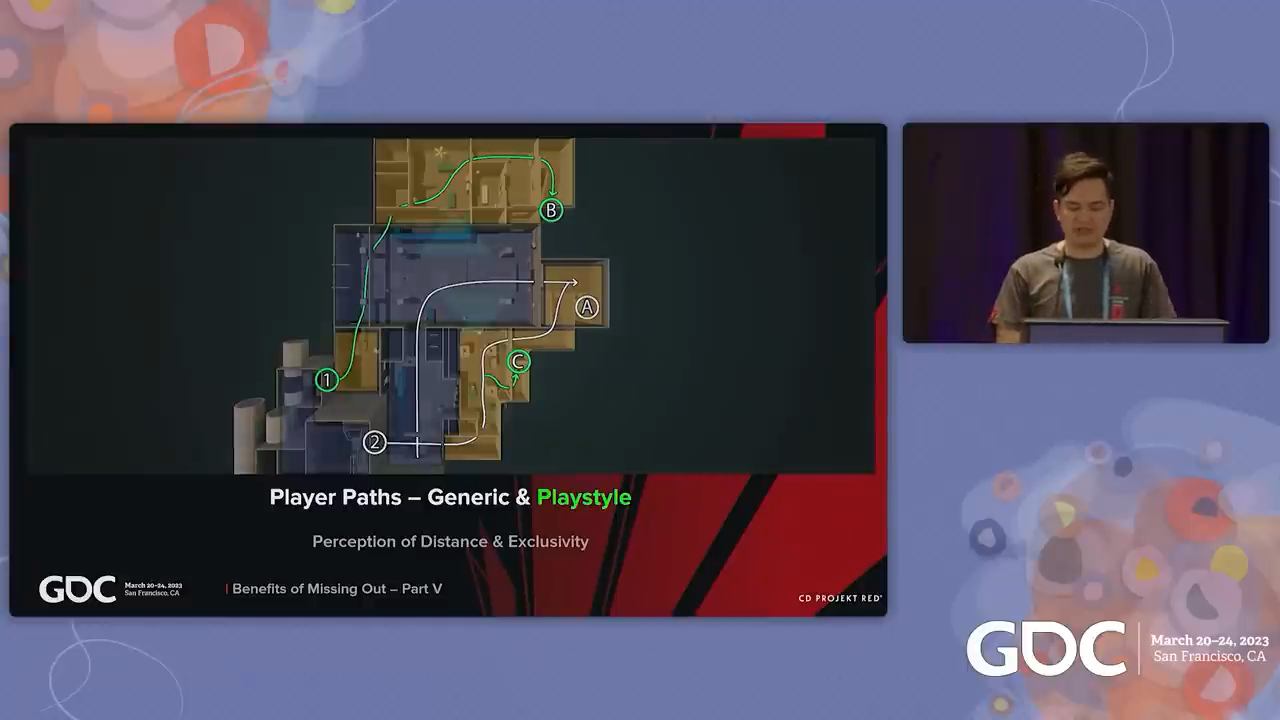
Tost applies all three principles to an experimental blockout he had created before the R&D project. The first iteration showed all the classic problems: low payoff for playstyle paths, violated perception of distance (paths running parallel), and violated perception of exclusivity (players can see where other paths lead).
The second iteration adds a small section (one room, two corridors, and a branch) that transforms the experience:
- Beat distribution becomes more even between Discovery and Exploration, creating room for meaningful rewards
- Additional passages to the lower floor are placed with no direct line of sight to each other
- Entrances to exploration beats are moved as far apart as possible
- The generic path now leads through the middle, while previously generic paths become playstyle exclusives
- A landmark room in the center helps players build mental maps — they can peek at it from exploration beats, but it doesn't reveal how alternative paths work
- Lower floor entrances are hidden from each other — from no entrance can you see any of the other options
The cost of these improvements was remarkably low — effectively one room and two corridors with a branch. The perception change was dramatic.
7. Summary
Source: https://www.youtube.com/watch?v=lXLRd5Kah-I&t=3030s
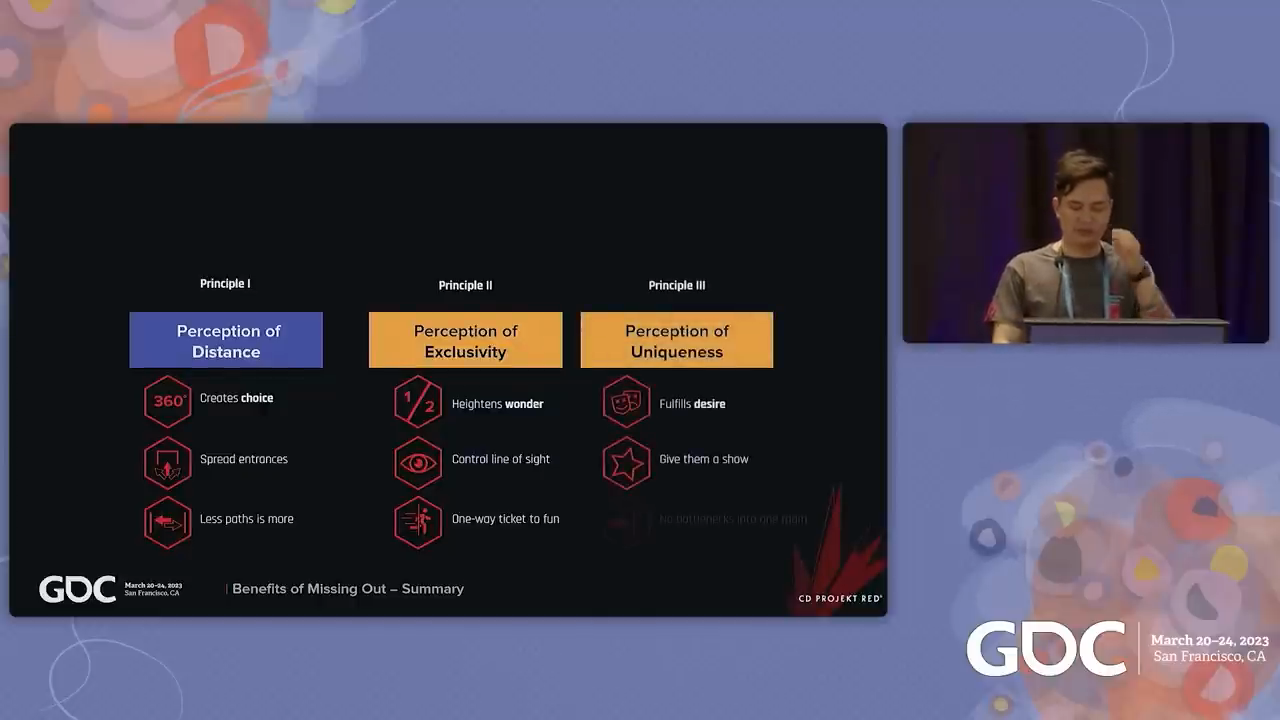
Principle I — Perception of Distance → Creates choice
- Spread entrances far apart
- Less paths is more (quality over quantity)
Principle II — Perception of Exclusivity → Heightens wonder
- Control line of sight between paths
- Use one-way passages to commit players
Principle III — Perception of Uniqueness → Fulfills desire
- Provide exclusive content on each path ("give them a show")
- Don't bottleneck paths into the same room
All three principles are particularly effective when applied through the Discovery and Exploration beat structure — maximizing choice in discovery zones and maximizing reward in exploration zones.
The overarching lesson: the "benefits of missing out" — when players know they're experiencing something exclusive, something others might not see, the experience becomes inherently more valuable. The designer's job isn't to ensure every player sees everything. It's to ensure that whatever path a player takes, they feel like it was the right one.
8. References
- Miles Tost. "Benefits of Missing Out: What 'Cyberpunk 2077' Taught Us About Non-Linear Level Design." GDC 2023, Level Design Summit. https://www.youtube.com/watch?v=lXLRd5Kah-I