Abstract
Problem: Why has Minecraft — a game with no score, no mandatory objectives, and blocky graphics — become the best-selling video game in history with over 350 million copies sold? What makes its game loop so compulsive that players routinely lose hours in sessions they planned to last minutes?
Approach: We dissect Minecraft's interlocking mechanical systems — from its 20-tick-per-second simulation to its nested hierarchy of gameplay loops — analyzing how simple deterministic rules produce emergent complexity, how progression systems balance freedom with direction, and how the game's technical foundation shapes every player experience.
Findings: Minecraft's genius lies not in any single mechanic but in the recursive nesting of self-reinforcing loops across multiple timescales. The core mine→craft→build→explore cycle operates at every level simultaneously, from second-to-second block placement to month-long mega-projects. Its deliberately non-linear progression, combined with infinite procedural worlds that maintain local scarcity within global abundance, creates a motivational structure that transitions players seamlessly from extrinsic survival goals to intrinsic creative expression — the precise shift that transforms short-term engagement into years-long retention.
Key insight: Minecraft's enduring dominance comes from being a game of emergent complexity from simple rules — a design philosophy where the "low floor, high ceiling" principle is applied so consistently that the same system (blocks + crafting + physics) serves both a seven-year-old building their first dirt house and an engineer constructing a working CPU from redstone.
1. The Core Loop: Mine, Craft, Build, Explore
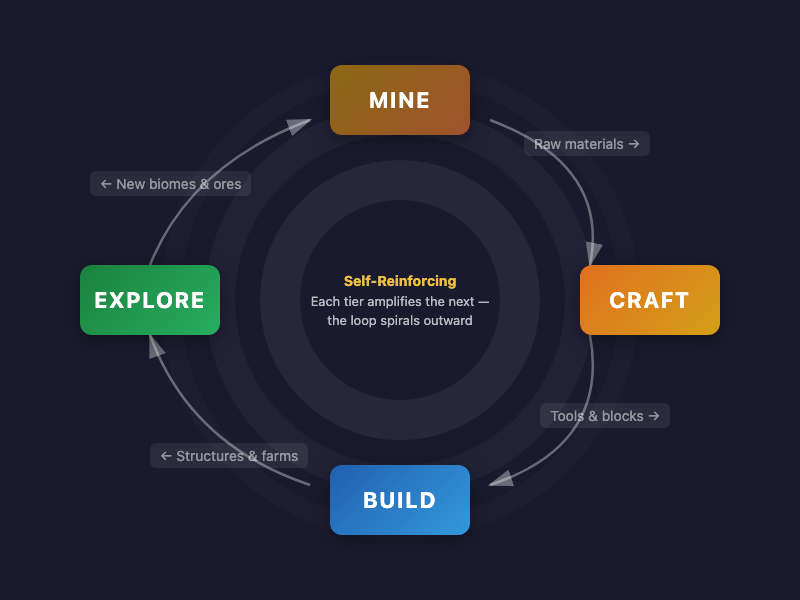
Every analysis of Minecraft begins with the same observation: the core loop is almost absurdly simple. You mine blocks. You craft those blocks into tools and materials. You build structures. You explore to find new blocks. Then you mine again.
What makes this loop exceptional is not its simplicity but its self-reinforcing nature. Each step in the cycle doesn't merely lead to the next — it amplifies it. Mining with a wooden pickaxe yields stone. Stone tools mine faster, unlocking iron. Iron tools mine faster still, and open access to diamonds. Diamonds mine obsidian, which opens the Nether, which contains netherite, which creates the most powerful tools in the game. Each tier doesn't just increment capability — it multiplicatively expands the space of what's possible.
This is a textbook positive feedback loop, but Minecraft adds a critical element that prevents it from collapsing into boredom: the rewards at each tier aren't just faster versions of the same activity. Diamond tools don't just mine faster — they grant access to entirely new dimensions, literally new worlds with new blocks, new threats, and new crafting possibilities. The loop spirals outward rather than merely accelerating.
1.1. The Psychology of "Just One More"
The compulsive quality of Minecraft's loop exploits several well-documented psychological mechanisms, but does so more elegantly than most games because the exploitation is structural rather than artificial.
Variable ratio reinforcement appears in cave exploration: you never know when the next diamond vein, dungeon, or lush cave will appear. Unlike a slot machine, the reward is contextual — those diamonds aren't abstract points but tools for a project you've been planning. This ties variable reinforcement to goal gradient effect: the closer you get to completing a build or reaching a new tier, the more motivated you become to continue.
The Zeigarnik effect — the tendency to remember and fixate on incomplete tasks — is weaponized by Minecraft's open-ended building. A half-finished house nags at the player's mind. But completing the house reveals a need for interior decoration, which requires dyes, which requires flowers, which requires exploring new biomes. Completion of one task reliably generates two more.
Perhaps most importantly, Minecraft sessions extend because the game operates on continuous partial completion. There is no natural stopping point. No level-complete screen, no chapter ending, no save-point rhythm. The game's autosave means you can quit at any moment, but the absence of a designed stopping point means there's never a moment that suggests stopping. The player must actively decide to stop playing against the grain of whatever they're currently doing.
2. Nested Loop Hierarchy
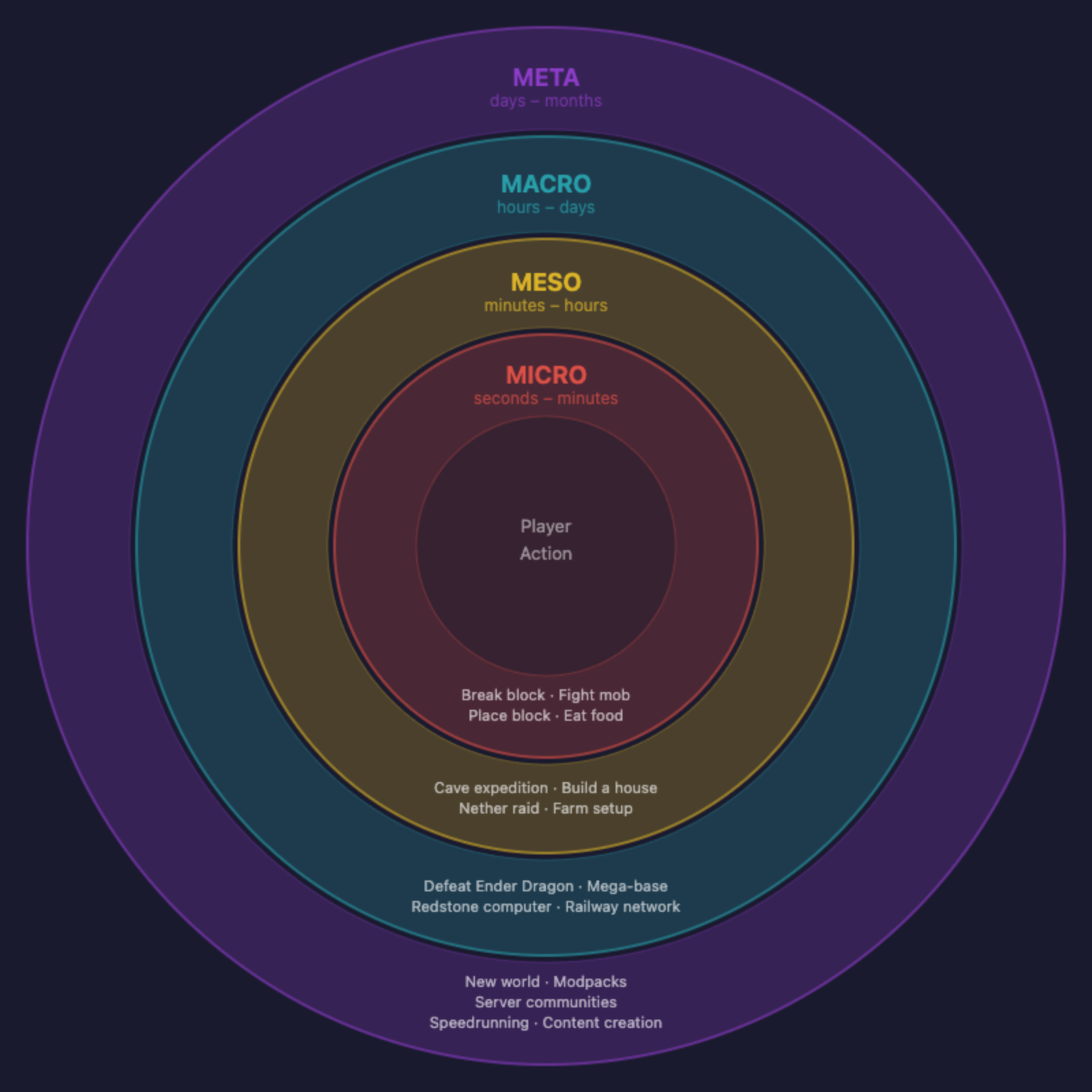
The brilliance of Minecraft's structure becomes apparent when you examine how its loops nest across timescales. This is not a single loop but a fractal hierarchy where loops at every level feed into and draw from loops above and below them.
2.1. Micro Loops (Seconds to Minutes)
The fastest loops are tactile and immediate. Mine a block: satisfying particle effect, item pops into inventory, the world changes. Fight a mob: dodge, strike, dodge, collect drops. Place a block: instant visual feedback, the structure grows. Eat food: hunger bar refills.
These loops are tight, responsive, and provide constant micro-rewards. The block-mining loop is particularly well-calibrated — breaking a block takes just long enough to feel like an action with weight, but not so long that it becomes tedious. The 0.25-second breaking time for dirt with a shovel vs. the 1.5-second time for stone with a pickaxe vs. the 25-second time for obsidian with a diamond pickaxe creates a spectrum where material value is communicated through temporal investment.
2.2. Meso Loops (Minutes to Hours)
At the medium scale, loops become goal-oriented sequences of micro loops. Exploring a cave system: the player navigates, fights mobs, mines ores, manages inventory, and must decide when to retreat with their haul vs. push deeper for better rewards. Building a house: a sequence of material gathering, placement, evaluation, adjustment.
A Nether expedition exemplifies the meso loop's design. The player must prepare (craft gear, brew potions, gather blocks), execute (navigate hostile terrain, locate a fortress, acquire blaze rods and wither skeleton skulls), and return safely. The preparation phase creates investment. The execution phase creates tension. The return creates relief and reward. This three-act structure emerges naturally from the game's mechanics without any scripting.
2.3. Macro Loops (Hours to Days)
Macro loops encompass entire project arcs. Defeating the Ender Dragon requires a chain of accomplishments: reaching the Nether, finding a fortress, acquiring Ender pearls, locating a stronghold, preparing for the final fight. Building a mega-base involves planning, material calculation, scaffolding, construction, and decoration across multiple sessions.
What's remarkable is that macro loops are entirely player-constructed. The game suggests the dragon fight through the advancement system and the discovery of End portal frames, but the player sets the pace and determines whether this goal even matters to them. Some players spend hundreds of hours never visiting the End, instead pursuing self-defined macro goals like automated farms, railway networks, or pixel art projects.
2.4. Meta Loops (Days to Months)
The longest loops transcend individual worlds. Starting a new survival world with fresh knowledge, attempting a modpack that transforms the game's mechanics, joining a multiplayer server with its own economy and social dynamics, or taking on the "all advancements" challenge — these meta loops explain why Minecraft retains players across years.
The meta loop is sustained by the game's extraordinary moddability and the social ecosystem that has grown around it. A player who has "completed" vanilla Minecraft can install a modpack like RLCraft or Create and encounter what amounts to an entirely new game built on familiar foundations. The knowledge transfers but the challenges don't, creating what educational psychologists call desirable difficulty — hard enough to engage, but grounded enough in prior knowledge to avoid frustration.
3. Progression Systems: Freedom Within Structure
Minecraft's progression is deliberately non-linear, but it is not structureless. Understanding the distinction is key to understanding the game's design.
3.1. The Tier Ladder
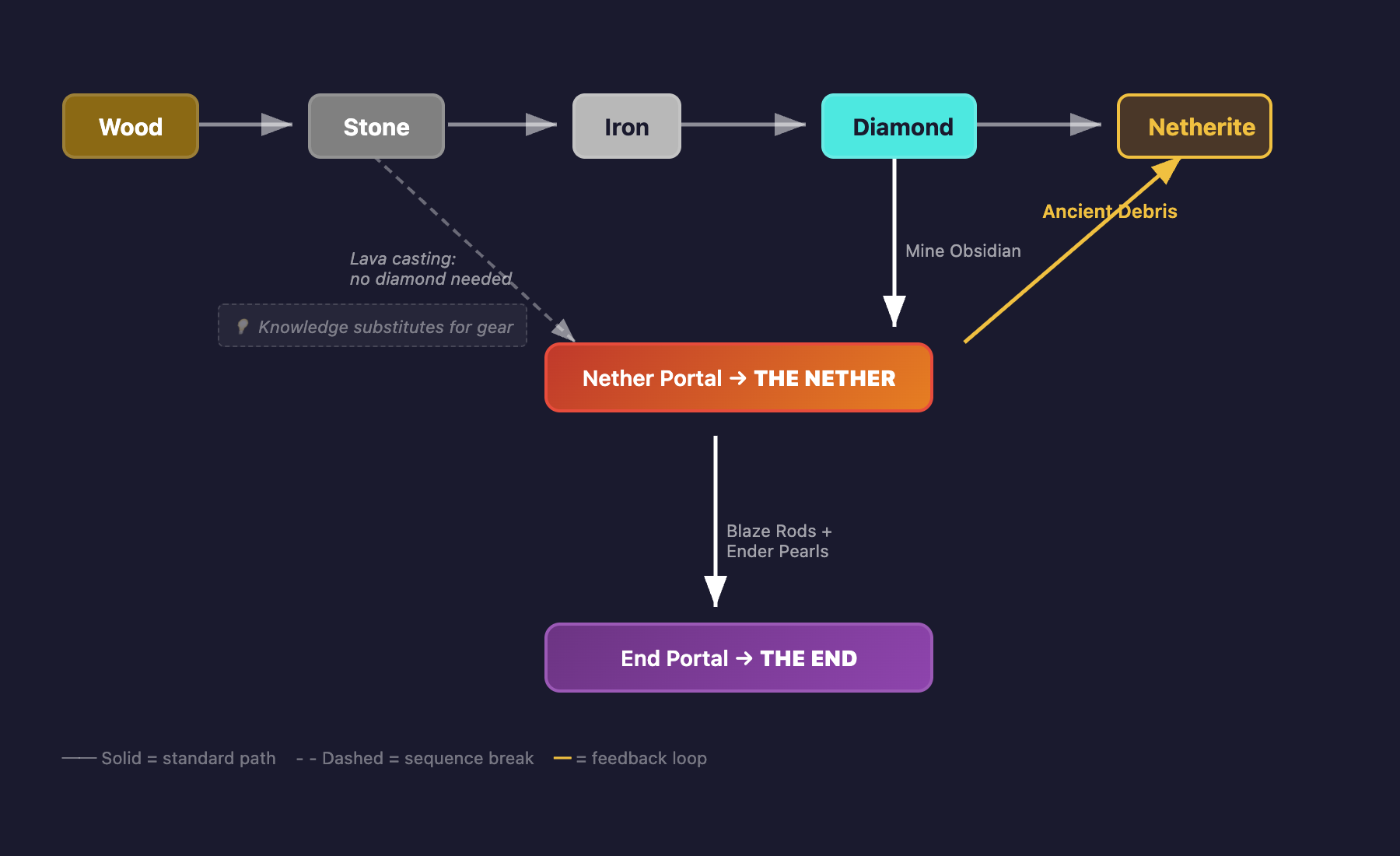
The tool and armor progression follows a clear hierarchy: wood → stone → iron → diamond → netherite. Each tier provides strictly better stats. But critically, tiers are not gates — they are shortcuts. A player can fight the Ender Dragon in leather armor with stone tools. It will be extremely difficult, but it's possible. The speedrunning community has proven that the entire game can be completed in under ten minutes by sequence-breaking nearly every intended progression step.
This creates a fundamentally different relationship to progression than a game like Terraria, where boss drops are prerequisite materials for the next tier of equipment. In Minecraft, progression is about efficiency and comfort, not permission. You don't need diamond armor — you want it because it makes everything easier and opens more options.
3.2. Dimensional Gating: Soft vs. Hard
Minecraft uses a clever system of gates that feel mandatory but often aren't.
The Nether portal requires obsidian, which requires a diamond pickaxe to mine conventionally. This appears to be a hard gate: you must reach diamond tier before accessing the Nether. But players discovered that you can construct a portal without ever mining obsidian — by casting it in place using lava and water. This "lava casting" technique turns a seemingly hard gate into a soft one, accessible to any player who understands the mechanics.
The End portal is a harder gate: it requires Ender eyes, which need both Ender pearls (from Endermen) and blaze powder (from Nether blazes). The Nether is genuinely required to reach the End. But even here, the path is flexible — you can trade with Piglins for Ender pearls instead of hunting Endermen.
This soft-gate philosophy means that knowledge and creativity substitute for material progression. A knowledgeable player with wooden tools can outperform an ignorant player with diamond equipment. This inverts the typical RPG relationship between time-invested and capability, rewarding mastery and understanding over grinding.
3.3. The Enchanting Gamble
The enchanting system introduces controlled randomness into progression. Spending experience levels and lapis lazuli at an enchanting table yields random enchantments influenced by the enchantment level. The player can see one of the three offered enchantments but not the others, creating a gambling dynamic where risk (spending resources) meets uncertain reward.
This system is brilliant because it adds replayability to the progression treadmill. A player who has full diamond gear still has reason to continue mining and fighting — they need better enchantments. And the randomness means that perfect gear requires either patience or the willingness to combine imperfect enchantments at an anvil, adding another crafting/resource loop.
4. The Tick System: 20 Heartbeats Per Second
Minecraft's simulation runs at exactly 20 ticks per second, and this fixed rate is the heartbeat underlying every mechanical system in the game. Understanding ticks is essential to understanding why Minecraft feels the way it does and why its emergent complexity is possible.
4.1. Game Ticks and Timing
Each tick is 50 milliseconds of game time. One in-game day is exactly 24,000 ticks, or 20 real-world minutes. This means a full day-night cycle — the most fundamental rhythm of survival gameplay — lasts exactly 20 minutes: 10 minutes of daylight, 1.5 minutes of sunset, 7 minutes of night, and 1.5 minutes of sunrise.
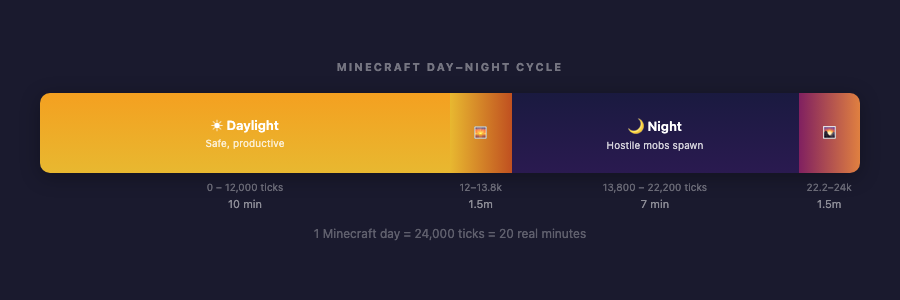
This 20-minute cycle is masterfully calibrated. It's long enough that daytime feels productive and spacious — you can accomplish meaningful tasks. But it's short enough that night arrives with genuine urgency. The cycle creates a natural meso-loop: survive the night, use the day, prepare for the next night. As players progress and nighttime becomes less threatening, this loop fades, but by then the player has transitioned to self-directed goals.
4.2. Random Ticks and Living Worlds
Every game tick, the game selects a number of blocks in each loaded chunk section (16×16×16 blocks) to receive a "random tick." The default random tick speed is 3, meaning 3 random blocks per section per tick. This mechanic drives crop growth, leaf decay, fire spread, grass spreading to dirt, ice forming, and numerous other slow processes.
The beauty of the random tick system is that it creates organic, non-deterministic behavior from deterministic rules. Two identical wheat farms will grow at slightly different rates. Fire spreads unpredictably. Grass reclaims cleared land gradually. These effects make the world feel alive — things happen even when the player isn't directly interacting with them.
Random ticks also create the fundamental tension of farming: crops grow on their own schedule, not the player's. This introduces waiting, which pushes players to do other things while crops grow, naturally diversifying gameplay and preventing tunnel vision.
4.3. Redstone Ticks and Emergent Computing
Redstone — Minecraft's electrical/logic system — operates on a 2-tick delay per component by default (0.1 seconds real time). Repeaters can be set to 1-4 tick delays. This tick-based timing means redstone circuits are fundamentally digital and synchronous, making them behave like real electronic circuits.
The consequences are profound. Players have built functioning 8-bit CPUs, graphing calculators, playable recreations of other games, and even rudimentary neural networks inside Minecraft. While technically debated whether Minecraft's redstone is strictly Turing complete (world size is finite, and redstone signals have distance limits), in practice it functions as a general-purpose computing substrate. Players have demonstrated arbitrary program execution using redstone, pistons, and observers.
This represents perhaps the most extreme example of emergent complexity in any game. The designers created redstone as a simple power-transmission mechanic. The community turned it into a programming language.
5. World Generation and the Exploration Loop
Minecraft's procedural world generation is the engine that prevents its loops from going stale. An infinite world means there's always more to discover, but the specific structure of that generation determines how exploration feels.
5.1. Chunks and the Infinite Frontier
The world generates in 16×16 block columns called chunks, created on demand as the player approaches. Each chunk's terrain, biome assignment, structure placement, and ore distribution is determined by the world seed — a single integer that produces a deterministic but practically infinite landscape.
This chunk-based generation creates an interesting property: global abundance with local scarcity. The world contains functionally infinite diamonds, villages, and rare biomes. But at any given moment, the player's local environment has limited resources. You might need to travel a thousand blocks to find a jungle biome for bamboo. This maintains exploration pressure in a world where nothing is truly scarce — the cost is distance and time, not absolute rarity.
5.2. The 1.18 Revolution
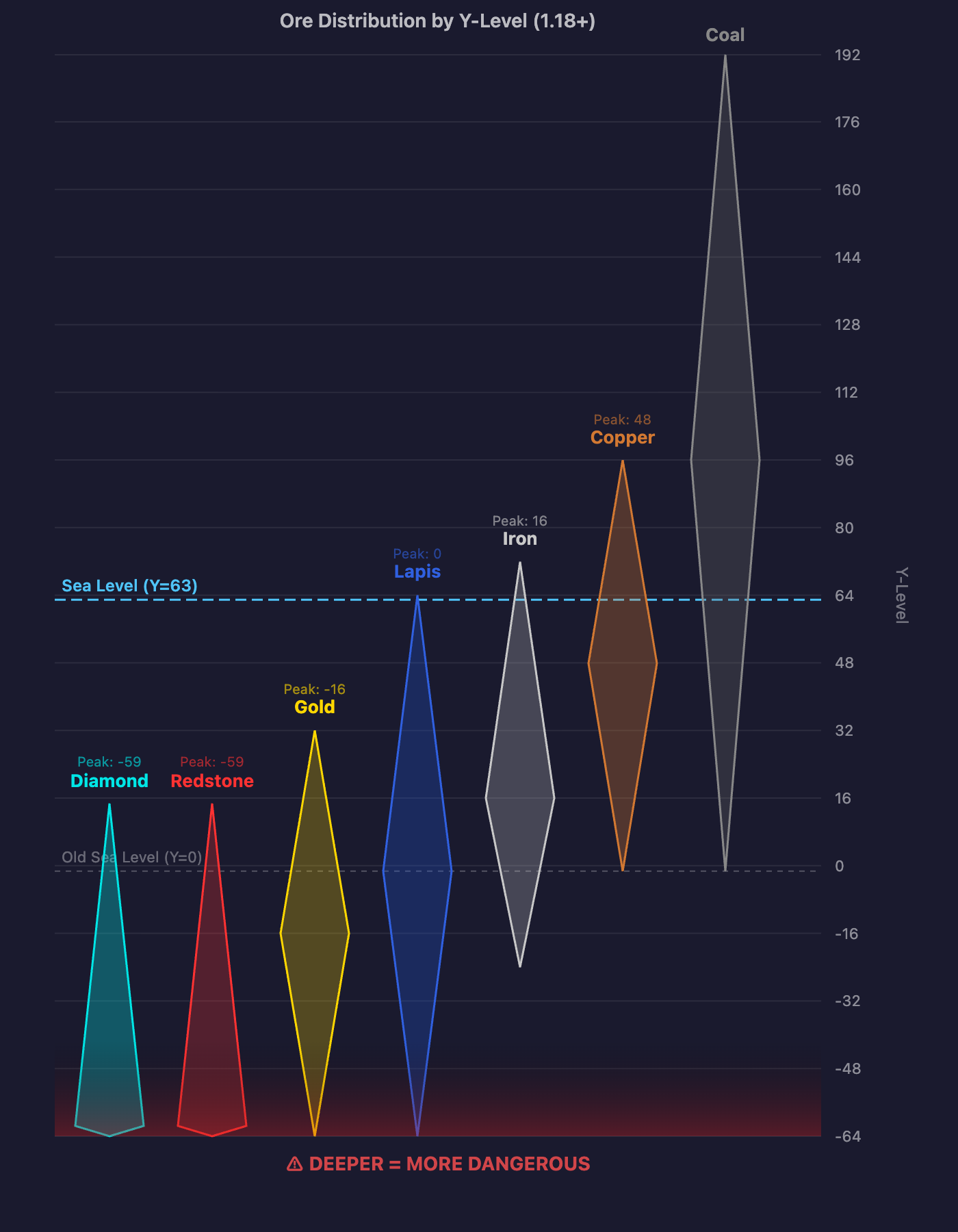
The Caves & Cliffs update (1.18, released November 2021) fundamentally restructured world generation. The world height expanded from 256 to 384 blocks (Y -64 to Y 320). Cave generation was overhauled with noise-based algorithms producing massive caverns, aquifers, and new cave biomes like lush caves and dripstone caves.
Ore distribution was redesigned to use triangular distributions centered on specific Y-levels rather than the previous uniform distributions. Diamonds concentrate at Y=-59, iron peaks around Y=16, copper at Y=48. This created depth-based risk/reward: the deepest ores are the most valuable but require the most dangerous descent through vast underground caverns where hostile mobs spawn freely.
The "reduced air exposure" mechanic further reinforced this: some ores that generate adjacent to air blocks have a chance to be skipped, rewarding branch mining (creating your own tunnels) over spelunking (exploring natural caves). This is a subtle but effective design choice that gives players a reason to engage with both exploration and systematic mining.
5.3. Biome Variety as Exploration Reward
As of recent versions, Minecraft features over 60 distinct biomes spanning three dimensions. Each biome offers unique visual aesthetics, exclusive resources, and different mob spawning conditions. Mushroom islands offer safety from hostile mobs. Badlands yield extra gold. Deep dark biomes contain the warden — the most dangerous mob in the game — and ancient cities with unique loot.
Biome diversity transforms exploration from mere resource gathering into something closer to tourism. Players travel to see what's over the next hill. The visual contrast between a flower forest and a frozen peaks biome is dramatic enough that the journey itself becomes rewarding, independent of any resources collected.
5.4. Structures as Narrative Breadcrumbs
Generated structures — villages, temples, strongholds, woodland mansions, ocean monuments, bastions, ancient cities — serve as narrative punctuation in an otherwise narrative-free world. They provide loot, challenges, and context clues. The progression from surface villages (safe, friendly) to Nether bastions (hostile, rewarding) to End cities (alien, powerful loot) mirrors the player's progression in capability and confidence.
Strongholds deserve special mention: they are the only required structure in the game's main progression, housing the End portal. Their placement — randomly distributed but detectable via Ender eye trajectories — creates a treasure-hunt dynamic that forces engagement with exploration mechanics at a macro scale.
6. Emergent Complexity from Simple Rules
The gap between Minecraft's simple rule set and the complexity of player-created systems is arguably the widest in gaming history. This section examines how that emergence works.
6.1. The Simplicity Foundation
Minecraft's core rules are few and learnable:
- The world is made of blocks on a grid
- Blocks have properties (hardness, transparency, behavior)
- Certain block combinations in a crafting grid produce items
- Items have functions (tools mine, weapons damage, food heals)
- Mobs follow behavioral rules (zombies chase players, creepers explode, villagers trade)
- Physics is simplified (gravity for sand/gravel only, water/lava flow, redstone power transmission)
From these rules, the community has derived: automatic crop farms, mob grinders, item sorters, flying machines, TNT cannons, duplication exploits, zero-tick growth chambers (patched in some versions), iron golem farms, raid farms, gold farms, enderman farms, shulker shell farms, wither skeleton skull farms, and functioning computers.
6.2. Mob Farms: Gaming the Spawn Algorithm
Mob spawning follows precise rules: mobs spawn in dark spaces within 128 blocks of a player, on solid blocks, with caps per mob category. Knowing these rules, players construct enclosed dark chambers at specific heights and distances from the player's AFK position, channeling spawned mobs into kill chambers using water flows.
The design of an efficient mob farm requires understanding spawn rates (1/2000 chance per chunk per tick), despawn ranges (mobs beyond 128 blocks instantly despawn), pack spawning behavior, and the global mob cap (70 hostile mobs in Java Edition). Players who build these systems are, without realizing it, performing systems analysis and optimization on a simulated ecosystem.
6.3. Water and Lava: Infinite Resource Loops
Water and lava follow simple flow rules, but water has a special property: two water source blocks adjacent to an empty block create a new source block. This means a 2×2 square of water is infinite — you can scoop from it forever. Similarly, combining lava and water in specific configurations produces cobblestone or stone infinitely.
These mechanics enable self-sustaining resource loops — the player invests once in setting up the system and extracts indefinitely. Cobblestone generators, basalt generators, and obsidian generators form the foundation of automated construction material production. Simple rules, profound consequences.
6.4. Community-Discovered Mechanics
Some of the most impactful mechanics in Minecraft were never intended by the designers:
TNT cannons exploit the fact that TNT entities are affected by explosions. By carefully timing multiple TNT blocks, players launch TNT projectiles thousands of blocks — useful for breaking into ocean monuments or creating spectacular weapons on PvP servers.
Zero-tick farms exploited a timing quirk where crops could be instantly grown by removing and replacing the block beneath them within a single game tick. Mojang partially patched this, but the discovery demonstrated how deeply the community understands (and pushes) the tick system.
Carpet duplication and other glitches arise from edge cases in block update logic. The technical Minecraft community catalogues these extensively, treating the game as a complex system to be reverse-engineered rather than merely played.
7. Player-Set Goals and Long-Term Motivation
Minecraft's approach to player motivation is fundamentally different from most games, and understanding this difference explains its unusual retention characteristics.
7.1. The Post-Dragon Problem (That Isn't)
Most games face a crisis when the player completes the main objective. Minecraft technically has this moment — defeating the Ender Dragon triggers a credits sequence. But remarkably, most players don't experience this as an ending. They return to the Overworld and keep playing.
This works because by the time players reach the dragon, they have accumulated hours of investment in their world: builds, farms, collections, unfinished projects. The dragon fight is a milestone, not a destination. The advancement system reinforces this — there are dozens of advancements beyond the dragon, many requiring obscure activities (ride a strider, sleep at extreme heights, kill every hostile mob type).
7.2. The Motivation Transition
Minecraft executes a gradual handoff between motivation types that most games never attempt:
Early game (hours 1-10): Extrinsic motivation dominates. Survive the night. Get better tools. Find diamonds. The environment pressures the player into action.
Mid game (hours 10-50): Mixed motivation. The player has conquered basic survival and begins choosing their own goals. Build a nice house. Explore the Nether. Create a farm. Extrinsic and intrinsic motivations coexist.
Late game (hours 50+): Intrinsic motivation dominates. The player builds for beauty, creates redstone machines for intellectual satisfaction, organizes resources for the pleasure of optimization. Survival pressures are trivial. The player is self-directed.
This transition mirrors Maslow's hierarchy: once basic needs (shelter, food, safety) are met, the player naturally ascends to self-actualization (creative expression, mastery, community contribution). Very few games facilitate this transition because most games are their extrinsic systems — remove the external pressure and there's nothing left. Minecraft's building and redstone systems ensure there's always a "higher floor" to reach.
7.3. Social and Competitive Meta-Games
Multiplayer servers create entirely new motivation structures. Economy servers create trading loops. Faction servers create political and military dynamics. Creative servers create collaborative architectural challenges. Speedrunning creates a competitive optimization meta-game where knowledge of the game's procedural generation rules becomes a competitive advantage (knowing how to read terrain to locate structures, knowing which trades are available from which villager types).
The speedrunning community exemplifies emergent meta-gaming: a game designed for open-ended exploration becomes a tightly optimized race where world-record runs complete the dragon fight in under 10 minutes through routing, probability manipulation, and near-perfect execution.
8. Comparisons: What Makes Minecraft Different
Placing Minecraft alongside its peers reveals what it does uniquely and what tradeoffs that uniqueness requires.
8.1. Terraria: Structure vs. Freedom
Terraria offers deeper combat, more items, more bosses, and a more directed progression. Its boss gates create clear milestones: you must defeat the Wall of Flesh to access hardmode, you must defeat Plantera to access the jungle temple. This creates a more satisfying power curve but limits player agency. Terraria players follow a largely predetermined progression path; Minecraft players forge their own.
Terraria compensates with content density — there are thousands of unique items, dozens of armor sets, and elaborate boss mechanics. Minecraft counters with spatial freedom — three dimensions of block placement versus Terraria's two, and a world that extends infinitely in all directions. Terraria is the better action-adventure game; Minecraft is the better sandbox.
8.2. Factorio: Automation as Core vs. Optional
Factorio makes automation its central verb. The game is building production lines. Minecraft offers automation as an advanced, optional activity. This means Factorio captures the optimization-driven player more effectively, but it excludes players who don't enjoy systems thinking. Minecraft's automation layer (redstone, hoppers, observers) rewards those who seek it without punishing those who ignore it.
The comparison illuminates a key design principle: Minecraft's systems are layered in depth rather than gated by complexity. A player can enjoy Minecraft fully without ever touching redstone, while a player cannot enjoy Factorio without engaging with automation.
8.3. Valheim: Survival Pressure vs. Creative Freedom
Valheim maintains survival pressure throughout the game — food, shelter, and combat readiness remain relevant even in late game. Its boss progression (Eikthyr → Elder → Bonemass → Moder → Yagluth) provides clear structure. Building is satisfying but constrained by structural integrity physics and material requirements.
Minecraft's creative mode eliminates survival pressure entirely, while survival mode makes it increasingly trivial. This is intentional — the game wants players to transition from survival to creation, and persistent danger would obstruct that transition.
8.4. Dwarf Fortress: Simulation Depth vs. Accessibility
Dwarf Fortress simulates individual dwarf personalities, moods, relationships, and a complete history of the world. Its depth is unmatched in gaming. But its interface historically required extraordinary patience, and its complexity limits its audience.
Minecraft chose the opposite extreme: minimal simulation, maximal accessibility. A seven-year-old can understand blocks. This choice is why Minecraft has 350 million sales and Dwarf Fortress has a devoted but comparatively tiny community. The lesson is not that accessibility is better than depth — it's that the two exist on a continuum, and Minecraft found a point on that continuum that maximizes audience size without sacrificing the capacity for depth (via redstone, command blocks, and mods).
9. Design Lessons: Why It Works
Minecraft's success encodes several generalizable design principles.
9.1. Low Floor, High Ceiling, Wide Walls
Seymour Papert's educational design framework describes Minecraft perfectly. Low floor: anyone can break and place blocks. High ceiling: experts build functioning computers, automated farms, and architectural marvels. Wide walls: the same mechanics support builders, engineers, explorers, fighters, farmers, and socializers.
This is achieved through the radical simplicity of the block as a universal element. Every material in the game is a cube (with rare exceptions). This constraint, which appeared to be a graphical limitation in 2009, turned out to be the game's most important design decision. Blocks are a universal building grammar — they snap to a grid, they stack predictably, they're visually legible from any distance. The constraint enables creativity by eliminating the friction of precise placement that plagues more "realistic" building systems.
9.2. Bartle Taxonomy Coverage
Richard Bartle's player type taxonomy identifies four types: Achievers, Explorers, Socializers, and Killers. Most games serve one or two types. Minecraft serves all four:
- Achievers pursue advancement completion, material tiers, and self-set challenges
- Explorers wander infinite worlds discovering biomes, structures, and mechanics
- Socializers build together on servers, create communities, share creations
- Killers compete in PvP servers, speedrunning, and challenge modes
Creative mode and peaceful mode further expand coverage to players who don't fit neatly into any category — those who simply want to build without pressure.
9.3. Risk/Reward Calibration
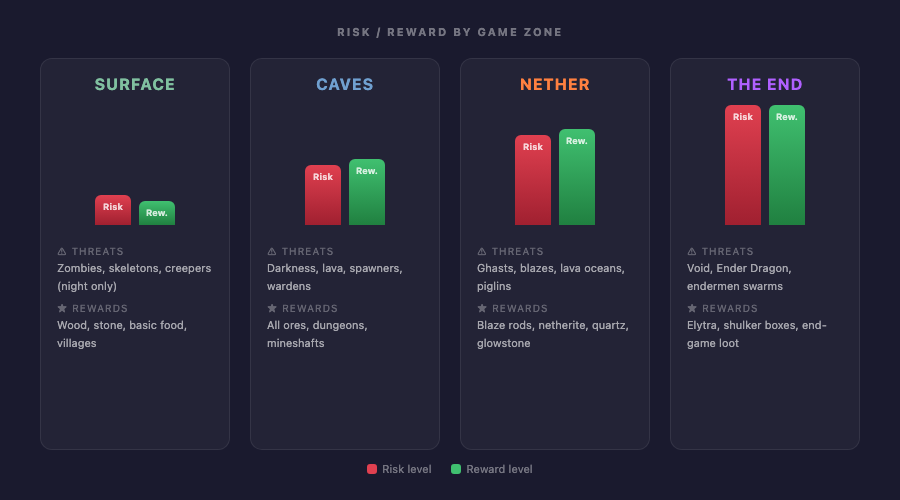
Minecraft's risk/reward curves are carefully tuned to player progression:
- Surface at night: Moderate danger, moderate reward. Teaches combat basics.
- Cave exploration: High danger (darkness, lava, mob spawners), high reward (ores, structures).
- Nether: Very high danger (ghasts, blazes, lava oceans, bastions), very high reward (unique materials, progression requirements).
- End: Extreme danger (void, dragon, endermen), extreme reward (elytra, shulker boxes — the two most game-changing items).
The elytra (wings allowing flight) and shulker boxes (portable storage) are particularly well-placed rewards because they fundamentally change how the player interacts with the world. Post-elytra Minecraft is a different game than pre-elytra Minecraft, providing a dramatic payoff for end-game exploration.
9.4. Why Blocky Works
Minecraft's visual style is often discussed as a limitation that players "look past." This misunderstands its function. The blocky aesthetic is a design feature that serves multiple purposes:
Building grammar: Blocks snap to a grid, making construction intuitive. There's no alignment problem, no floating-point precision issue, no awkward gaps. What you see is what you build.
Player projection: Low-detail visuals invite the player's imagination to fill in the gaps. A blocky house becomes your house in your mind more readily than a photorealistic one, because your brain does interpretive work that creates personal investment.
Readability: At any distance and any angle, the game is visually parseable. You can identify blocks, structures, mobs, and terrain features instantly. This clarity supports the game's spatial reasoning demands.
Performance: Simple geometry means the game runs on virtually any hardware, from phones to supercomputers. This technical accessibility is a major factor in its 350-million-unit sales.
10. Conclusion
Minecraft's mechanical design is a case study in how simple, well-chosen rules can produce systems of arbitrary complexity. Its nested loop hierarchy — from the half-second satisfaction of breaking a block to the months-long arc of a mega-build project — creates engagement across every timescale. Its non-linear progression respects player autonomy while maintaining enough structure to prevent paralysis. Its procedural generation creates infinite novelty within a learnable framework. And its tick-based simulation provides the deterministic foundation that makes emergent complexity — from automatic farms to functioning computers — reliably possible.
The game's unprecedented commercial success (350 million copies as of 2025) is not a fluke of marketing or timing. It is the result of a design that serves the widest possible range of players — from children placing their first block to engineers debugging redstone timing issues — through a single, coherent set of mechanics. In game design terms, Minecraft didn't just find a successful loop. It found a loop that contains all other loops.
11. References
- Minecraft Wiki: Tick — Technical documentation of the tick system
- Minecraft Wiki: Mob Spawning — Spawn algorithm details
- Minecraft Wiki: World Generation — Procedural generation documentation
- Alan Zucconi: The World Generation of Minecraft — Analysis of 1.18 world generation
- BBC: Minecraft becomes first video game to hit 300m sales — Sales milestone reporting
- Wikipedia: List of best-selling video games — Sales data (350M as of 2025)
- Wikipedia: Compulsion Loop — Psychological framework for game engagement
- Gamedeveloper.com: Compulsion Loops & Dopamine in Games — Analysis of intrinsic vs extrinsic motivation in game design
- Gamedeveloper.com: Minecraft vs Terraria — Design comparison analysis
- Game Design Skills: Designing the Core Gameplay Loop — Game loop design framework with Minecraft examples
- VSquad: What Is a Gameplay Loop? — Gameplay loop taxonomy
- Reddit r/gamedesign: Minecraft's Caving Game Loop — Community analysis of cave exploration mechanics
- Reddit r/gamedesign: The Two-Week Minecraft Phase — Discussion of Minecraft engagement patterns
- Minecraft Forum: 8-Bit Computer (Turing Complete) — Redstone computing projects
- Stack Exchange: Is Minecraft Turing-Complete? — Technical discussion of redstone computational capabilities